


close
Choose Your Site
Global
Social Media
Views: 222 Author: Gill Transmission Publish Time: 2026-05-23 Origin: Site


When you design or source outboard gears for marine engines, understanding the addendum of gears is critical for achieving smooth power transmission, long service life, and low noise in the gearcase. In this guide, I'll walk through gear addendum from a practical outboard engineering perspective, combining standard gear theory with real‑world insights from marine drive systems. [linkedin]

In classical gear nomenclature, the addendum is the radial distance between the pitch circle and the top of a gear tooth. In simple terms, it is the tooth height above the pitch circle, and it influences how deeply two gears mesh and how they share load under torque. [khkgears]
For standard metric gears, the addendum is usually equal to one module (for example, \(ha = 1.0 m\) in many standard designs), which creates a balance between strength, smooth contact, and manufacturability. In marine outboard gearboxes, however, the effective addendum must be considered together with material, surface treatment, and lubrication conditions to prevent pitting and scuffing in the harsh seawater environment. [cmlabs]
From an outboard transmission engineer's standpoint, gear addendum directly affects:
- Contact ratio and smoothness of engagement, which drives noise and vibration in the lower unit. [geartechnology]
- Load distribution across the tooth, impacting fatigue life and resistance to tooth breakage during high‑torque acceleration. [linkedin]
- Clearance and backlash, which determine how forgiving the system is to shaft misalignment and thermal expansion in a marine environment. [linkedin]
In a compact outboard gearbox where space is limited and cooling is constrained, even a small deviation from the correct addendum can lead to premature wear, chipped teeth, and increased noise complaints from boat owners. That is why experienced marine suppliers refine addendum selection based not only on textbook formulas, but also on field feedback from real vessels. [mraa]
To work confidently with outboard gear drawings and supplier catalogs, you should understand the core terms that interact with addendum: [khkgears]
- Pitch circle / pitch diameter – The imaginary circle where gear teeth effectively mesh; addendum is measured above this circle. [linkedin]
- Addendum (ha) – Tooth height above the pitch circle, typically \(1.0 m\) in standard metric gears. [khkchilun]
- Dedendum (hf) – Tooth depth below the pitch circle down to the root; together with addendum it defines total tooth height. [linkedin]
- Tooth height (h) – Sum of addendum and dedendum; in many standards \(h \approx 2.25 m\). [khkchilun]
- Clearance – Gap between the tooth tip of one gear and the tooth root of its mate; directly influenced by addendum and dedendum choices. [linkedin]
- Backlash – The slight play between mating teeth, necessary to avoid binding and to accommodate manufacturing tolerances and expansion. [linkedin]
For outboard gears, these parameters must be optimized together so the gearset survives high shock loads during shifts, low‑speed trolling, and high‑speed cruising without excessive noise or wear. [cmlabs]
In many catalog spur and helical gears, standard addendum designs are used because they are easy to manufacture and interchange. In marine outboard applications, engineers may also apply modified addendum to solve specific performance problems. [geartechnology]
- Typically addendum = 1.0 module for standard metric gears. [khkchilun]
- Balanced design for general mechanical transmission. [linkedin]
- Suitable when load, speed, and lubrication conditions are within standard assumptions.
- Slightly longer or shorter addendum than the standard value. [geartechnology]
- Used to increase contact ratio, improve smoothness, or adapt to special center distances. [geartechnology]
- In outboard gearsets, can help reduce gear whine or compensate for deviations in center distance due to housing constraints. [mraa]
However, aggressive addendum modifications without proper analysis may reduce tooth root thickness, increasing the risk of tooth breakage under impact loads, such as emergency shifting or hitting waves at high speed. [geartechnology]
From years of working with marine transmission parts, I've seen three primary ways in which addendum design decisions play out in the field.
A higher effective addendum can raise the contact ratio, meaning more teeth are in contact at once, which can smooth the transmission of torque and reduce tonal whining. However, if clearance becomes too small, any misalignment or contamination in the oil can produce harsh noise spikes and micro‑pitting at the tooth tips. [geartechnology]
Addendum affects the contact position on the tooth flank. In high‑torque outboard units, you want the compressive stress to remain away from the very tip of the tooth, where material is thinner and more vulnerable. A well‑balanced addendum helps ensure that the load is carried in the stronger mid‑flank region, improving bending and contact fatigue life. [geartechnology]
Marine gearcases may experience shaft deflection due to propeller thrust, hull movement, and varying load conditions. If addendum and clearance are too tight, even small deflections can lead to edge contact and localized damage. Outboard‑optimized gears often keep sufficient clearance and carefully polished tip relief to stay robust under these real‑world misalignments. [mraa]
When we design or select outboard gears at Ningbo Gill Transmission Parts Co., LTD., we look beyond nominal catalog values and focus on how addendum behaves in real marine settings. [cmlabs]
Key checks include:
1. Module and pressure angle selection
- Confirm that the chosen module allows an addendum that delivers the required tooth strength within the available gearbox envelope. [khkgears]
- Standard pressure angles (such as 20°) are often preferred for their strength and lower sensitivity to misalignment. [linkedin]
2. Material and surface treatment
- Case‑hardened or nitrided steels with optimized addendum and dedendum can better resist pitting and scuffing in marine lubricants. [geartechnology]
- Surface finishing at the tooth tip is especially important when clearance is small and addendum is close to the standard limit. [geartechnology]
3. Lubrication regime
- Ensure the lubricant film thickness remains adequate at the upper contact region near the tooth tip, particularly at high RPM. [geartechnology]
- For high‑performance outboards, we consider both the viscosity and additive package of the gear oil to protect the addendum region. [cmlabs]
4. Shifting loads and shock events
- Some outboard gearsets see severe shock loads during forward–reverse shifts and rapid throttle changes. [mraa]
- Addendum must be chosen so that tooth tips do not chip or deform under these transient loads, which can rapidly worsen backlash and noise. [geartechnology]
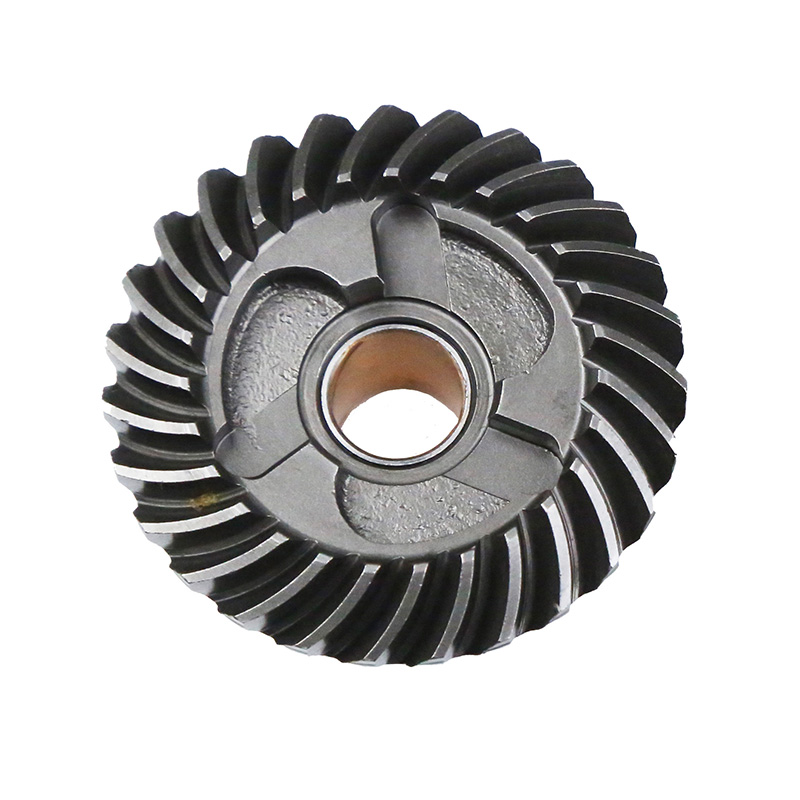
To make this more concrete, imagine you receive an outboard gear drawing from your engineering team or a supplier. At minimum, you will see values such as: [khkgears]
- Module (m)
- Number of teeth (z)
- Pressure angle
- Addendum (ha) and dedendum (hf), or total tooth height (h)
- Pitch diameter (d)
If the drawing states module = 3 mm and addendum ha = 3 mm, the design is using a standard addendum equal to one module. When you review this as a buyer or engineer, you should ask: [khkchilun]
- Does this addendum match the mating gear's dedendum so that there is adequate clearance? [linkedin]
- Is the center distance in the gearbox fixed, and if so, does the addendum design maintain a stable contact pattern under load? [geartechnology]
- Has the supplier validated this design in marine conditions (saltwater, varying temperatures, real operating cycles)? [cmlabs]
A professional outboard gear manufacturer will be able to explain not just the numerical value of addendum, but also why that value was chosen for your specific engine power, RPM, and propeller load. [cmlabs]
From customer feedback and failure analyses, several recurring issues are linked—directly or indirectly—to addendum and related geometry. [mraa]
Common symptoms include:
- Whining or howling noise at specific RPM ranges
- Chipped or polished tooth tips visible on disassembly
- Uneven wear patterns, with excessive contact near the tip or root
- Rapid backlash growth, leading to clunking during shifts
- Localized pitting near the pitch line or slightly above
While these problems can have multiple causes (lubrication, misalignment, material defects), inaccurate or poorly considered addendum values can exacerbate all of them. That is why post‑installation feedback from boat owners and service technicians is so valuable for tuning future designs. [mraa]
At Ningbo Gill Transmission Parts Co., LTD., we specialize in the design and production of outboard gears and marine transmission components, and we treat addendum as a practical tuning parameter rather than a static catalog number. [cmlabs]
Our typical process includes:
1. Application analysis
- We review engine power, peak torque, RPM range, propeller specification, and intended vessel type (e.g., fishing boat, workboat, leisure craft). [mraa]
- Based on this, we determine whether standard addendum is sufficient or whether slight modification is needed for noise or durability targets. [geartechnology]
2. Simulation and calculation
- Using established gear formulas and finite‑element methods, we simulate contact patterns and stress distributions along the tooth, especially near the addendum region. [khkgears]
- We then validate that clearance and backlash are robust across manufacturing tolerances.
3. Prototype and field testing
- We run prototype sets in real marine duty cycles, monitoring noise, vibration, and wear. [cmlabs]
- Feedback from field tests feeds directly back into fine adjustments to addendum, profile modifications, and surface finishing.
4. Continuous improvement
- Customer reviews and warranty data are analyzed to identify patterns—such as noise at certain RPM or repeat tip‑wear cases—that might be linked to addendum or related geometry choices. [mraa]
- We then update our internal standards and drawing templates so future projects benefit from this accumulated experience.
By integrating classical gear theory with first‑hand outboard experience, we deliver gearsets that perform reliably in the demanding marine environment. [cmlabs]
If you are:
- Designing a new outboard motor or upgrading an existing lower unit
- Experiencing recurrent noise, vibration, or gear failures in service
- Evaluating alternative suppliers for OEM‑grade outboard gears and marine transmission parts
you should work with a manufacturer who not only understands gear formulas, but also lives in the marine environment every day. The right partner will help you select or refine addendum values that align with your target performance, cost, and durability. [mraa]
If you are looking for outboard gears and marine transmission components that are engineered for real marine conditions—not just for test benches—our team at Ningbo Gill Transmission Parts Co., LTD. can help you. [cmlabs]
- We can review your existing gear drawings, including addendum and related geometry, and suggest practical improvements for noise, durability, and manufacturability. [geartechnology]
- We offer custom design, prototyping, and volume production of outboard gears tailored to your engine platforms and market positioning. [cmlabs]
Get in touch with our engineering team to discuss your next outboard project or to troubleshoot current performance issues in your gearcases. [cmlabs]
1. What is the standard addendum for metric gears used in outboard gearboxes?
In many standard metric gears, the addendum is equal to one module, meaning \(ha = 1.0 m\), although final values may be adjusted for marine conditions and specific gearbox layouts. [khkchilun]
2. How does addendum affect gear noise in an outboard engine?
Addendum influences the contact ratio and position of contact on the tooth flank; if optimized, it can reduce whining and vibration, but if clearance becomes too tight, noise may actually increase. [linkedin]
3. Can I use catalog standard gears for an outboard gearbox?
Standard addendum gears are convenient, but they are not always ideal for marine duty cycles, where shock loads, misalignment, and lubrication conditions may require profile modifications or adjusted addendum. [cmlabs]
4. What are signs that the addendum or related geometry is not suitable?
Common signs include tip chipping, localized pitting near the tooth tip, rapid backlash growth, and narrow or uneven contact patterns on the tooth flank in used gearsets. [linkedin]
5. How do I work with a supplier to optimize gear addendum?
Share your engine torque curve, RPM range, gearbox layout, and field issues (noise, failures); an experienced marine gear supplier can then run calculations and simulations to refine addendum and profile modifications for your application. [mraa]
1. KHK Gears – "Addendum of Gears | Gear Nomenclature" (accessed 2026). <https://khkgears.net/new/gear_knowledge/gear-nomenclature/addendum-of-gears.html> [khkgears]
2. KHK Gears – "Basic Gear Terminology and Calculation" (accessed 2026). <https://khkgears.net/new/gear_knowledge/abcs_of_gears-b/basic_gear_terminology_calculation.html> [khkgears]
3. Mario Jurcevic – "Understanding the Basics of Gear Nomenclature" (LinkedIn article, 2024). [linkedin]
4. KHK (Chinese) – "What are the gear calculation formulas?" . [khkchilun]
5. Gear Technology Magazine – Technical articles on gear design and reverse engineering. <https://www.geartechnology.com/topics/technical> [geartechnology]
6. cmlabs – "SEO for Marine Shipping Companies" (industry SEO best practices). [cmlabs]
7. Google Search Central – "Creating Helpful, Reliable, People‑First Content" (E‑E‑A‑T guidelines). <https://developers.google.com/search/docs/fundamentals/creating-helpful-content> [developers.google]
8. MRAA – "A Boat Dealer's Guide to Winning with SEO" (marine‑sector SEO patterns). <https://mraa.com/a-boat-dealers-guide-to-winning-with-seo/> [mraa]


