


close
Choose Your Site
Global
Social Media
Views: 222 Author: Gill Transmission Publish Time: 2026-06-09 Origin: Site


Content Menu
● Why Gear Nomenclature Matters for Outboard Gears
● Core External Gear Terms You Must Know
>> Pitch Circle and Pitch Diameter
>> Addendum, Dedendum, and Whole Depth
>> Tooth Thickness, Backlash, and Clearance
● Involute Tooth Profile and Base Circle
● Gear Terminology Table (Quick Reference)
● How External Gear Nomenclature Applies to Outboard Gearboxes
>> Typical Outboard Gear Train Layout
>> Marine‑Specific Design Considerations
● Designing External Gears to ISO Concepts
>> Alignment with ISO 21771 and Modern Standards
>> Practical Workflow for Gear Specification
● Expert Tips: Avoiding Common Gear Issues in Outboard Systems
>> Tip 1: Never Mix Unknown Pressure Angles
>> Tip 2: Watch Backlash During Rebuilds
>> Tip 3: Consider Micro‑Geometry for Noise Control
● How to Choose External Gears for Marine and Outboard Applications
● Call to Action: Partner with a Specialist in Outboard Gears
● Frequently Asked Questions (FAQ)
Understanding external gear nomenclature is essential if you design, select, or maintain gears for marine systems such as outboard gearboxes, boat transmissions, and propulsion components. In this guide, I'll walk through the core terminology used in standard gear engineering, then connect those concepts directly to outboard gears and other marine power‑train parts developed and manufactured by companies like Ningbo Gill Transmission Parts Co., LTD. [home.engineering.iastate]
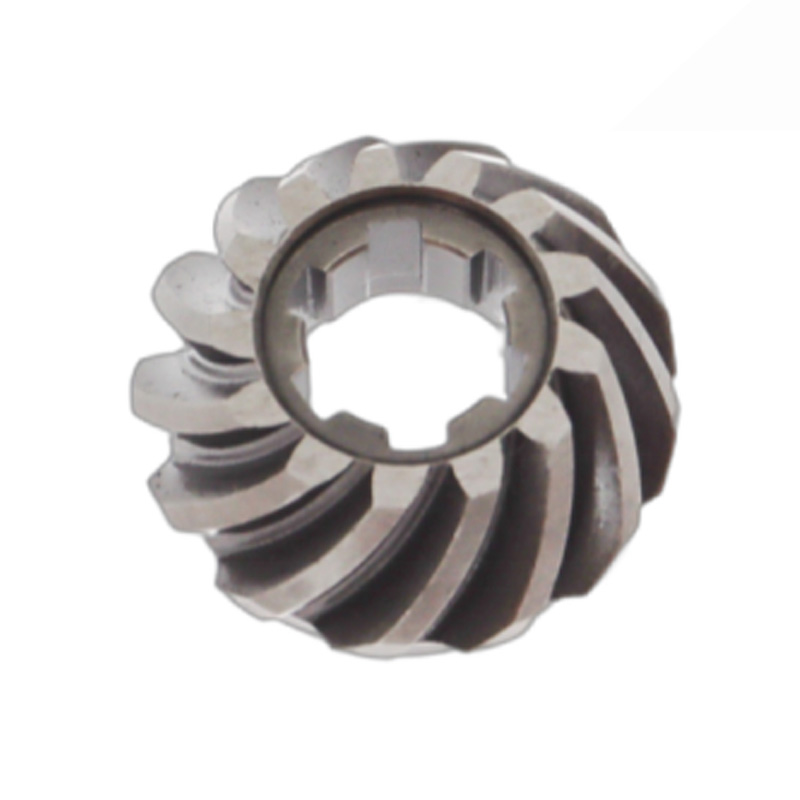
An external gear is a gear whose teeth are cut on the outside of a cylindrical or conical body. It typically meshes with another external gear (forming a gear pair) or with an internal gear, transmitting torque and changing speed or direction between rotating shafts. [grobinc]
In marine applications, external spur or helical gears are widely used in:
- Outboard lower units (forward and reverse gears in the gearcase) [youtube]
- Marine transmissions and reduction gearboxes for inboard engines [home.engineering.iastate]
- Auxiliary drives such as steering actuators and winch mechanisms [boatmarketingpros]
Because these gears often operate in harsh, lubricated, and high‑load environments, understanding their geometry and terminology is critical for reliability and safety. [boatmarketingpros]
Even small misunderstandings about terms like module, pressure angle, addendum, or backlash can lead to poor gear engagement, noise, or premature failure, especially in high‑torque marine gearcases. For an outboard gear manufacturer or buyer: [grobinc]
- Consistent terminology ensures designs comply with standards such as ISO 21771 for cylindrical involute gears. [standards.globalspec]
- Accurate nomenclature helps align engineering drawings, supplier specifications, and field maintenance manuals. [iso]
- Clear communication reduces risk when sourcing custom gears for different outboard brands or propulsion systems. [deercampdigital]
When we design outboard gears, we start every project by confirming key parameters—pitch, module, pressure angle, and tooth profile—with our OEM clients to avoid mismatches during production or assembly. [khkgears]
The pitch circle is an imaginary circle on which gear tooth spacing is defined. Its diameter is the pitch diameter, a foundational dimension for almost every gear calculation. [khkgears]
Key relationships include:
- Number of teeth (z)
- Pitch diameter (d)
- Module (m) or diametral pitch (P)
For metric gears, d=m×z, while in inch units, diametral pitch P=z/d. [grobinc]
In outboard gearcases, the pitch diameters of the forward and reverse gears are chosen to achieve the desired gear ratio, typically in the range of about 1.8:1 to 2.5:1 for many recreational engines. [youtube]
Module (m) is the metric measure that links the gear's pitch diameter and number of teeth:
- m=d/z (mm per tooth) [khkgears]
Diametral pitch (P) is the inch‑based alternative:
- P=z/d (teeth per inch) [grobinc]
These values essentially control tooth size. Larger modules (or smaller diametral pitches) mean bigger, stronger teeth suitable for high‑torque marine drives. [khkgears]
When we design heavy‑duty outboard gears, we often select a slightly higher module than an equivalent industrial gearbox, compensating for shock loads from propeller impacts and rapid gear shifts. [home.engineering.iastate]
The pressure angle is the angle between the line of action (where tooth forces act) and a line perpendicular to the line of centers. Common standard values are 20° and 25°. [qtcgears]
Pressure angle affects:
- Tooth strength and sliding
- Contact ratio and noise
- Interchangeability with existing gears
Many modern gears, including those in outboard gearcases, use 20° pressure angles as a balance of strength and smooth operation. Mixing gears with different pressure angles is a common cause of noise and premature wear in retrofit repairs. [qtcgears]
Tooth height is typically divided into:
- Addendum: Tooth height above the pitch circle [grobinc]
- Dedendum: Tooth depth below the pitch circle [grobinc]
- Whole depth: Sum of addendum and dedendum [grobinc]
Standard proportions often include:
- Addendum ≈ 1.0/P (inch gears) or mm (metric) [khkgears]
- Whole depth ≈ 2.157/P [grobinc]
Marine gears working in oil baths must balance adequate tooth height (for strength) with enough root clearance to avoid debris trapping and pitting in salt‑contaminated environments. [qikan.cmes]
Tooth thickness is the arc thickness at the pitch circle, while backlash is the small intentional gap between mating teeth. Clearance is the extra space at the tooth root beyond the mating tooth's addendum. [khkgears]
These parameters are vital because:
- Some backlash is necessary for lubrication and thermal expansion. [home.engineering.iastate]
- Too little backlash can cause binding and overheating under continuous load. [home.engineering.iastate]
- Too much backlash increases noise and impact loading during shifting, especially in outboard reverse engagement. [marineengine]
Experienced marine mechanics often diagnose clutch dog and gear wear by checking backlash and engagement marks on forward and reverse gears. [aomci]
Most modern external gears use an involute tooth profile, standardized by documents such as ISO 21771. [standards.globalspec]
Key geometric concepts include:
- Base circle: Circle from which the involute is generated [khkgears]
- Line of action: Path along which contact forces act between teeth [qtcgears]
The involute form ensures a constant velocity ratio even if the center distance changes slightly, which is particularly important in precision marine gear systems where housings can deform under high load. [standards.globalspec]
| Term | Definition (simplified) |
|---|---|
| Pitch circle | Reference circle that defines tooth spacing. (home.engineering.iastate) |
| Module (m) | Pitch diameter divided by tooth count (metric). (khkgears) |
| Diametral pitch | Tooth count divided by pitch diameter (inch). (grobinc) |
| Pressure angle | Angle of tooth force line vs. centerline normal. (qtcgears) |
| Addendum | Tooth height above pitch circle. (grobinc) |
| Dedendum | Tooth depth below pitch circle. (grobinc) |
| Backlash | Clearance between mating tooth flanks. (grobinc) |
| Base circle | Circle generating involute tooth. (khkgears) |
This table is useful when you align drawing notes from different suppliers or standards. [qikan.cmes]
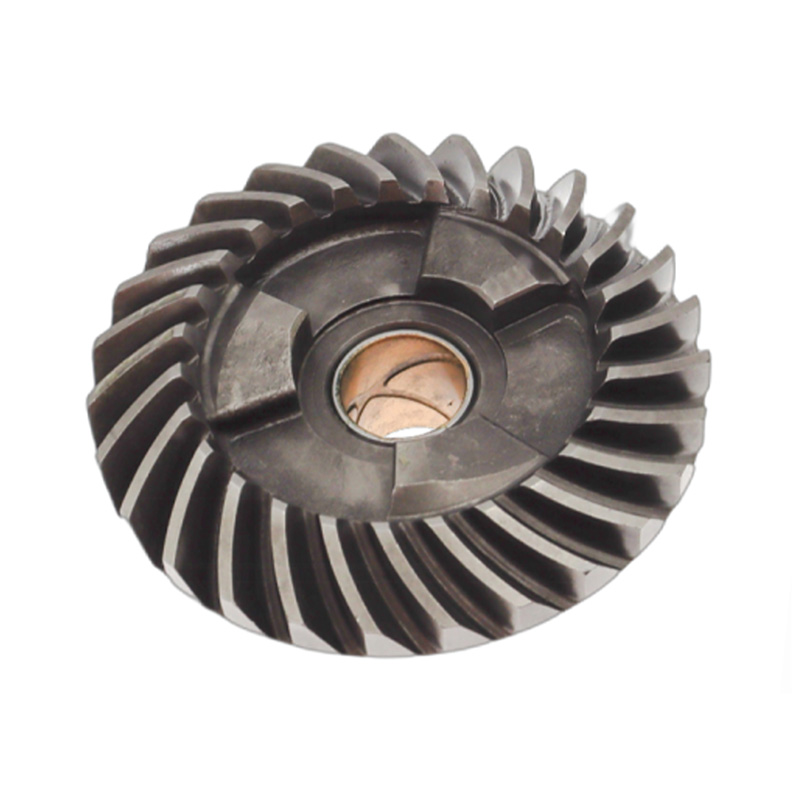
A conventional outboard lower unit contains:
- A drive pinion driven by the vertical driveshaft
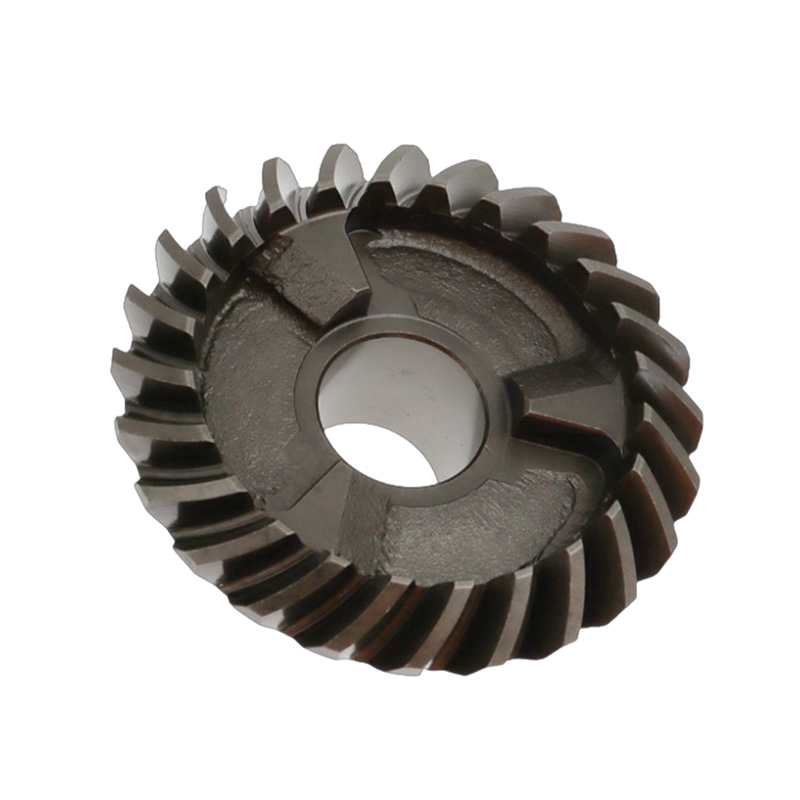
- Forward and reverse gears meshing with the pinion
- A clutch dog that slides to engage either forward or reverse gear [aomci]
Although these components are optimized for marine use, their gear terminology follows the same standards as industrial spur and helical gears. [standards.globalspec]
When designing or sourcing these gears:
- The module and pressure angle must match between pinion and gears. [qtcgears]
- Face width is chosen to handle repeated shock loads from propeller cavitation and impacts. [home.engineering.iastate]
- Backlash and undercut geometry are tuned to minimize slipping under heavy forward load, often by machining slight undercuts on clutch and gear lobes. [marineengine]
Marine environments introduce constraints that make precise nomenclature and geometry even more important:
- Corrosion and lubrication: Tooth root clearance and surface finish affect how oil films and contaminants behave. [boatmarketingpros]
- Noise and comfort: Recreational boaters are sensitive to gear whine; profile modifications and pressure angle choices must reflect this. [deercampdigital]
- Serviceability: Standardized terminology helps service manuals instruct technicians on clutch dog orientation and gear engagement checks. [aomci]
In our own practice, we frequently collaborate with boat OEMs to adjust micro‑geometry—such as tip relief and crowning—while maintaining the same base module and pressure angle, preserving interchangeability and simplifying spare‑part logistics. [qikan.cmes]
ISO 21771 defines the core geometric concepts and parameters for cylindrical involute gears, including terminology for tooth thickness, involute function, and flank modifications. While the 2007 edition is now withdrawn, its definitions remain influential and are reflected in many current standards and software tools. [iso]
For marine gear design, following these concepts offers:
- Predictable geometry compatible with global supply chains. [standards.globalspec]
- Easier integration with CAD/CAM and inspection systems used by international partners. [qikan.cmes]
- A common language when discussing deviations such as profile shift and corrections. [khkgears]
When we collaborate with marine OEM clients, a typical gear specification workflow includes:
1. Defining functional requirements: Torque, speed, duty cycle, and noise targets. [home.engineering.iastate]
2. Selecting base geometry: Module, tooth count, pressure angle, and face width. [grobinc]
3. Validating standards alignment: Checking compatibility with ISO‑style definitions and existing part families. [qikan.cmes]
4. Detailing tolerances and backlash: Including clear notes on allowable deviations for production and field assembly. [home.engineering.iastate]
By documenting each step using standard terminology, we ensure that both engineering and procurement teams can evaluate trade‑offs and suppliers more easily. [mtu]
One of the most frequent issues we see in field repairs is mixing gears with different pressure angles or modules simply because they "look similar". This can lead to: [khkgears]
- Poor contact patterns, causing localized pitting. [home.engineering.iastate]
- Increased noise and vibration under load. [qtcgears]
Always verify module and pressure angle before approving new or substitute parts. [standards.globalspec]
When rebuilding outboard gearcases:
- Measure backlash against OEM specs, not just "feel". [home.engineering.iastate]
- Avoid over‑tightening shims to remove all play; some clearance is necessary. [home.engineering.iastate]
Service forums and manuals frequently highlight that incorrect backlash contributes to clutch dog slipping and forward gear failures. [marineengine]
Even when basic parameters are correct, outboard owners complain about whine if micro‑geometry (tip relief, crowning) is ignored. Working with a gear specialist to introduce controlled corrections can: [qikan.cmes]
- Improve load distribution across the tooth. [home.engineering.iastate]
- Reduce sensitive whine at cruising speeds. [deercampdigital]
We often treat this as a second optimization stage after locking in the main gear nomenclature and dimensions. [standards.globalspec]
If you are a marine OEM, distributor, or technical buyer, you can use this simple selection process when evaluating external gears or outboard gears:
1. Define application and environment
- Outboard gearcase, inboard gearbox, or auxiliary drive. [boatmarketingpros]
- Saltwater vs. freshwater, expected duty cycle, and load. [deercampdigital]
2. Confirm core gear nomenclature
- Module or diametral pitch, pressure angle, tooth count, and face width. [grobinc]
- Check compatibility with existing mating gears. [standards.globalspec]
3. Review material and heat treatment
- Case‑hardened steels or special alloys for marine corrosion resistance. [home.engineering.iastate]
- Surface hardness suitable for repeated shock loading. [home.engineering.iastate]
4. Evaluate backlash and tolerances
- Target ranges based on OEM or standard guidelines. [grobinc]
- Ensure service adjustability via shims or spacers. [aomci]
5. Validate supplier expertise and QA
- Evidence of compliance with gear standards and marine projects. [wgcontent]
- Documented inspection reports and traceability. [semrush]
By combining this checklist with clear external gear terminology, you strengthen both technical quality and search visibility for buyers seeking "outboard gears", "marine gearboxes", or "external spur gears for boats". [boatmarketingpros]
If you are designing, upgrading, or troubleshooting a marine propulsion system, working with a specialist in outboard gears and marine external gear solutions will save you time and reduce risk. [deercampdigital]
By partnering with a dedicated manufacturer such as Ningbo Gill Transmission Parts Co., LTD., you gain:
- Custom‑engineered external gears tailored to your gear ratio, load, and noise requirements.
- Application‑specific advice on selecting module, pressure angle, and materials for marine environments.
- Consistent quality and documentation, including clear gear nomenclature on drawings, inspection reports, and service guides.
To discuss your outboard gear projects or request a technical consultation, reach out with your current drawings or performance targets and we'll help you define the optimal gear specification based on the concepts explained above. [mtu]
1. What is the difference between an external gear and an internal gear?
An external gear has teeth on the outside of the cylinder, while an internal gear has teeth on the inside. External gears typically mesh with other external gears or with internal gears to change speed and torque. [khkgears]
2. Why is the pressure angle important in outboard gears?
The pressure angle determines how forces are transmitted between teeth, affecting strength, noise, and compatibility. In outboard gearcases, a standard 20° pressure angle offers a good balance between durability and smooth operation. [qtcgears]
3. Can I replace a damaged marine gear with any gear that has the same number of teeth?
No. You must match module or diametral pitch, pressure angle, face width, and material, not just tooth count. Using a visually similar but geometrically different gear can cause rapid wear or failure. [khkgears]
4. How much backlash is acceptable in an outboard gearbox?
Acceptable backlash depends on the specific design and OEM recommendations. Too little clearance causes binding and heat, while too much causes noise and impact loading; marine service manuals and experienced mechanics rely on precise measurements and shimming. [marineengine]
5. What standards should I reference when specifying external gears?
You should use standards and references that define involute gear geometry and terminology, such as concepts from ISO 21771 and established technical guides on metric gear technology and basic gear terminology. [qtcgears]
1. ISO 21771 – *Gears – Cylindrical involute gears and gear pairs – Concepts and geometry* (GlobalSpec summary). Available at: <https://standards.globalspec.com/std/1024853/iso-21771> [standards.globalspec]
2. KHK Gears – *Basic Gear Terminology and Calculation*. Available at: <https://khkgears.net/new/gear_knowledge/abcs_of_gears-b/basic_gear_terminology_calculation.html> [khkgears]
3. GROB Inc. – *Spur Gear Terminology & Formulas*. Available at: <https://grobinc.com/spur-gear-terminology-formulas/> [grobinc]
4. Iowa State University – *Gear Nomenclature and Pitch Circle Concepts* (ME course notes). Available at: <https://home.engineering.iastate.edu/~gkstarns/me325/gears_1.pdf> [home.engineering.iastate]
5. QTC / Misumi – *Elements of Metric Gear Technology* (pressure angle explanation). Available at: <https://qtcgears.com/materials/catalogs/Tech.pdf> [qtcgears]
6. Marine Engine & AOMCI Forums – Field discussions on clutch dogs, forward gear lobes, and backlash in outboard gearcases. Examples at: <https://www.aomci.org/forums/topic/clutch-dog-trick-on-newer-25-35-gearcases/> and <https://www.marineengine.com/boat-forum/threads/clutch-dog-forward-gear-lobes.53586/> [aomci]
7. YouTube – *How an Evinrude gearbox works* (advanced look at outboard gear shifting). Available at: <https://www.youtube.com/watch?v=12dxb6d6pUk> [youtube]
8. Boat Marketing Pros – *Digital Marketing Tips for Marine Businesses* (SEO perspective for marine industry). Available at: <https://boatmarketingpros.com/digital-marketing-tips-for-marine-businesses/> [boatmarketingpros]
9. Deer Camp Digital – *SEO for Outdoor Brands* (content strategy for field‑relevant products). Available at: <https://deercampdigital.com/seo-tips-for-outdoor-brands/> [deercampdigital]
10. Semrush – *Google E‑E‑A‑T: What It Is & How It Affects SEO*. Available at: <https://www.semrush.com/blog/eeat/> [semrush]
11. WGContent – *E‑E‑A‑T for Content Quality*. Available at: <https://wgcontent.com/blog/eeat-content-quality-seo-geo/> [wgcontent]


