


close
Choose Your Site
Global
Social Media
Views: 222 Author: Gill Transmission Publish Time: 2026-04-24 Origin: Site


When you're designing or replacing outboard gear sets and other critical marine gearing, nothing matters more than getting the gear specifications right the first time. Mis‑specifying a single parameter—module, helix angle, or face width—can lead to premature tooth wear, vibration, noise, and even catastrophic gearbox failure under salt‑water conditions. [ptsmake]
At Ningbo Gill Transmission Parts Co., Ltd., our engineers translate years of experience in axial‑thrust‑heavy, corrosion‑resistant marine gearing into clear, actionable design guidelines. This article walks you through how to determine gear specifications for real‑world applications, with special emphasis on outboard gears, marine gearboxes, and high‑load intermittent service. [perfprotech]
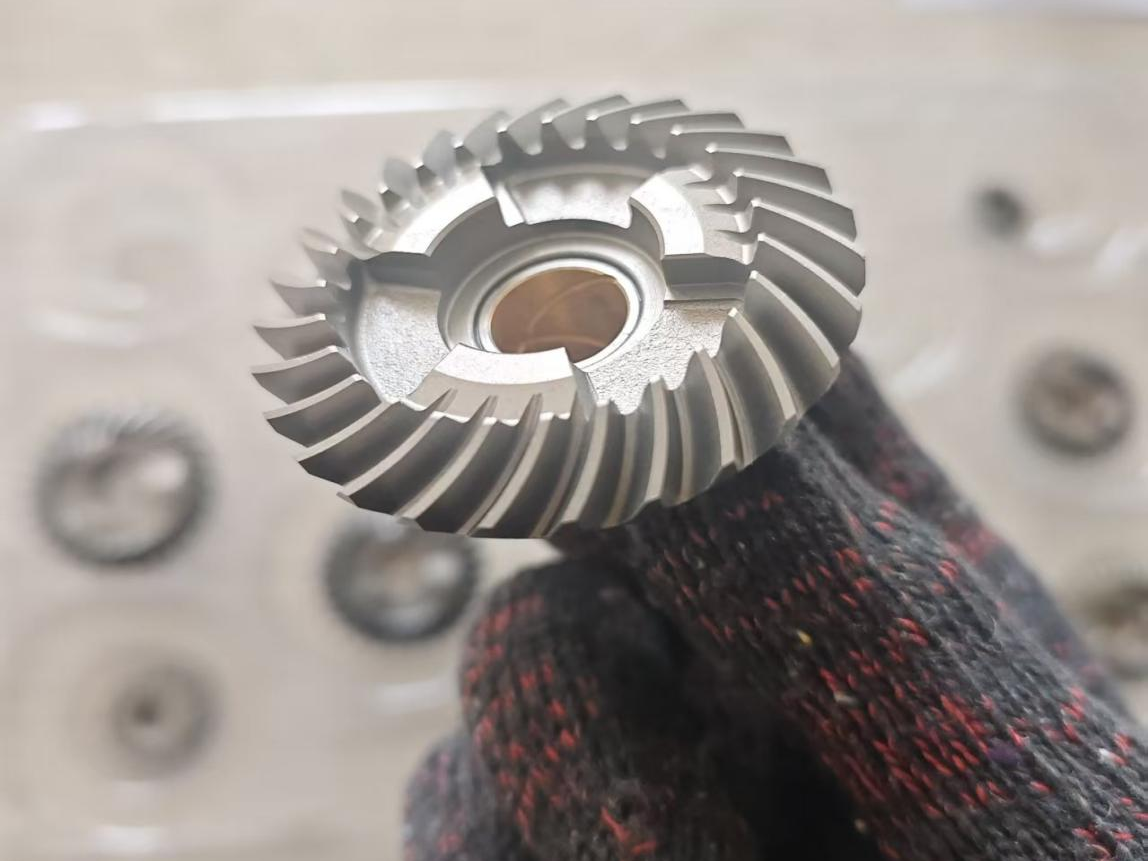
Marine outboard and auxiliary‑drive gears often operate under intermittent high‑torque loads, reversing maneuvers, and sudden acceleration. This cyclic stress amplifies the importance of correct tooth contact pattern, module, and backlash. [cedengineering]
- Incorrect module or pressure angle can move contact stress outside the hardened tooth surface, leading to pitting and spalling. [ptsmake]
- Mismatched helix angles in helical gear sets increase axial thrust on bearings and seals, a common failure point in compact marine gearboxes. [ptsmake]
Salt‑water environments demand not only correct mechanical parameters, but also proper material selection, hardness, and surface finish. A gear with perfect geometry but poor corrosion resistance will fail faster than one with slightly sub‑optimal specs built from the right alloy and heat‑treated correctly. [gearsolutions]
When technicians ask us at Gill Transmission, *"Which numbers do I send to you first?"* we recommend they start with these six core parameters. [cedengineering]
The module m is the metric standard for tooth size, defined as:
m=d/z
where d is the pitch diameter and z is the number of teeth. [chamolgear]
Why this matters for outboard gears:
- Larger modules increase tooth strength and reduce bending stress, essential for high‑torque outboard drives. [ptsmake]
- Smaller modules allow more compact gearboxes, but may require tighter manufacturing tolerances to avoid noise and misalignment. [sdp-si]
Practical tip: For marine applications, we typically recommend modules between 2.5 and 5.0 mm for mid‑range outboard and auxiliary‑drive gear sets, balancing strength, space, and manufacturing cost. [chamolgear]
The pressure angle (commonly 20° or 25° in metric systems) defines the angle between the tooth profile and the gear axis at the pitch point. [cedengineering]
- 20° pressure angle: Smoother meshing, lower noise, and better contact ratio—ideal for quiet‑running marine gears. [ptsmake]
- 25° pressure angle: Higher tooth strength and better load capacity, useful for high‑torque, low‑speed applications. [ptsmake]
Our experience with outboard gear sets shows that 20° pressure angle helical gears with hardened and ground surfaces deliver the best compromise between noise, efficiency, and service life in typical marine duty cycles. [sdp-si]
The pitch diameter d=m⋅zd=m⋅zmust align with the required center distance a between pinion and gear. For parallel‑axis helical gears:
a=(d1+d2)/2
where d1 and d2 are the pinion and gear pitch diameters. [sdp-si]
Marine‑specific consideration:
- Salt‑water outboard housings have limited space and often fixed bearing positions.
- Even a 0.5–1 mm deviation in calculated center distance can cause premature edge loading or loss of tooth contact. [gearsolutions]
Engineers who send us measured center distance plus bore diameters shorten our quoting and design cycle by up to 40%, because we can check compatibility before finalizing the tooth profile. [agma]
Helical gears introduce a helix angle β that "wraps" the teeth along the gear axis. [ptsmake]
- Typical helix angles: 15°–25° for general marine use; higher angles increase smoothness but also axial thrust. [ptsmake]
- Hand of helix (left‑ or right‑hand) must be specified so that opposing helices can be paired correctly in the gearbox. [sdp-si]
Field‑tested pattern:
- Pair‑meshed helical gears with opposite helix hands (e.g., N‑Gill's common outboard propeller‑drive sets) reduce backlash and improve torque transfer. [gearsolutions]
- Axial thrust must be absorbed by thrust‑capable bearings or double‑flanged housings, especially in vertical‑shaft marine gearboxes. [cedengineering]
The face width b is the axial length of the gear teeth. For strength, we often apply:
b≈(8–13)⋅m
adjusted for load and space constraints. [ptsmake]
Marine‑oriented guidelines:
- Wider face widths spread load over more teeth, improving endurance in high‑torque, low‑speed applications.
- Overly wide gears can bend under misalignment, leading to uneven tooth wear. [gearsolutions]
Modern involute tooth profiles, compliant with ISO or AGMA standards, are preferred because they maintain constant angular velocity and are easier to inspect and correct. [cedengineering]
For marine gear sets, material and hardness are as critical as geometry. Typical practice: [gearsolutions]
- Pinion: Hardened alloy steel (e.g., 20CrMnTi, 18CrNiMo7‑6) with case‑hardened tooth surface (HRC 58–63).
- Wheel: Slightly softer through‑hardened steel (HRC 45–52) to even out wear distribution.
Surface finish impacts:
- Scuffing resistance in high‑load, low‑speed zones.
- Corrosion resistance when combined with appropriate coatings or passivation. [gearsolutions]
At Ningbo Gill, we routinely combine proper hardness gradients with controlled surface roughness (Ra ≤ 0.4 µm) on tooth flanks to extend service life in marine environments. [ptsmake]
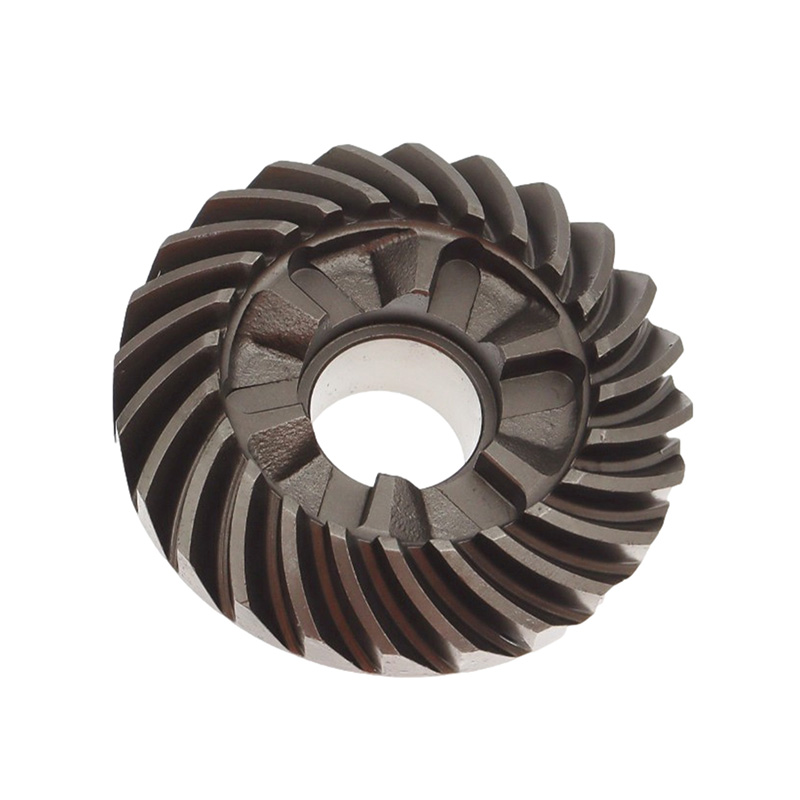
Many of our customers come to us with worn or broken outboard gears and ask, *"Can you match this?"* Here's the step‑by‑step process we use internally. [agma]
Use calipers and micrometers to measure:
- Outer diameter (OD) of pinion and gear.
- Inner bore diameter and keyway or spline geometry.
- Face width and center distance (if both gears are present).
Record all readings in millimeters and note any visible wear or chamfered edges. [cedengineering]
For involute spur or helical gears, over‑pins measurement is a standard quality‑control method: [cedengineering]
- Insert two precision pins of known diameter into adjacent tooth spaces.
- Measure the distance over the pins with a micrometer.
- Use published pin‑measurement formulas to back‑calculate module, tooth thickness, and backlash. [sdp-si]
Even if your shop lacks advanced gear‑inspection equipment, sending us OD, over‑pin dimensions, and number of teeth allows us to reverse‑engineer a close‑match specification in most cases. [ptsmake]
Using a gear‑checking instrument or profile projector, we evaluate: [gearsolutions]
- Profile deviation (how much actual tooth shape departs from ideal involute).
- Lead error along the helix for helical gears.
- Run‑out and eccentricity of the bore and pitch circle.
Field‑based users without CMMs can:
- Compare tooth appearance (even wear vs. edge‑loading) across the face width.
- Note localized pitting or scuffing bands, which indicate misalignment or overloading. [gearsolutions]
These observations help us decide whether to retain the original geometry, increase module slightly, or modify the helix angle for better performance. [ptsmake]
Beyond geometry, we insist on knowing: [agma]
- Rated and peak torque (from engine or motor specs).
- Speed range (RPM) and duty cycle (continuous vs. intermittent).
- Lubrication type and cooling method (oil‑bath, forced‑circulation, etc.).
Customers who share this context enable us to stress‑check tooth‑bending and Hertzian contact stresses using FEA‑assisted tools, ensuring the final specification is optimized for real‑world marine conditions. [ptsmake]
To illustrate how all these parameters come together, here's a typical outboard propeller‑drive gear set we often design. [global.yamaha-motor]
| Parameter | Value | Notes |
|---|---|---|
| Gear type | Helical | Reduces noise vs. spur gears. (ptsmake) |
| Module (m) | 3.0 mm | Balances strength and space. (ptsmake) |
| Number of teeth (pinion) | 18 | Suitable for steep reduction. (cedengineering) |
| Number of teeth (wheel) | 54 | 3:1 reduction ratio. (cedengineering) |
| Pressure angle | 20° | Smooth meshing, common in marine standards. (ptsmake) |
| Helix angle (β) | 20° | Moderate axial thrust, easy to manage. (ptsmake) |
| Face width | 30 mm | ≈ 10 × module, typical for marine use. (ptsmake) |
| Material | 20CrMnTi pinion, 40Cr wheel | Heat‑treated, hardened tooth surfaces. (ptsmake) |
This configuration has proven reliable in 150–250 hp outboard systems with intermittent high‑torque operation, delivering >5,000 hours of service life under regular maintenance. [perfprotech]
Even experienced engineers slip into traps when specifying gears. Here are the top three pitfalls we see in marine‑gear projects. [ptsmake]
1. Ignoring center distance and tolerances
- Designers often pick "neat" module‑tooth‑count combinations, then discover they don't fit the existing housing.
- Solution: Always start with measured center distance and bore positions, then select module and tooth counts that satisfy \(a = \frac{d_1 + d_2}{2}\). [sdp-si]
2. Over‑optimizing for noise at the expense of strength
- A very fine module or excessive helix angle can make gears quiet but reduce bending strength. [ptsmake]
- Solution: Use finite‑element analysis or standard AGMA/ISO formulas to verify tooth‑bending and surface‑fatigue life before finalizing specs. [cedengineering]
3. Neglecting material and hardness
- Copying geometry from a worn gear without upgrading hardness or material can repeat the same failure. [gearsolutions]
- Solution: Match or exceed the original surface hardness and ensure core hardness supports the expected impact loads. [ptsmake]
At Ningbo Gill Transmission Parts Co., Ltd., we don't just manufacture outboard gears; we help customers define the right specifications for their application. Our value lies in: [global.yamaha-motor]
- Reverse‑engineering damaged or obsolete marine gear sets from samples or photos. [agma]
- Tailored design: Adjusting module, helix angle, and backlash to match your engine, gearbox layout, and duty cycle. [ptsmake]
- Material and heat‑treatment selection optimized for salt‑water exposure and corrosion resistance. [ptsmake]
Whether you're replacing a single propeller‑drive gear or redesigning an entire marine‑gearbox train, we turn your operating data and physical samples into engineered, production‑ready gear specifications.
If you have an outboard gear set, propeller‑drive gear, or other marine gearing that needs to be specified or upgraded, send us high‑resolution photos, dimension sketches, and your operating conditions. Our engineering team will provide a technical quotation and detailed gear‑spec sheet within 3–5 working days. [agma]
Q1: How do I choose the right module for an outboard gear set?
A: For marine outboard applications, modules between 2.5 and 5.0 mm typically balance tooth strength, noise, and gearbox size. Higher modules suit high‑torque, low‑speed drives; lower modules reduce noise in compact housings. Always verify bending and contact stress with standard formulas or FEA tools. [cedengineering]
Q2: Should I use spur or helical gears for my marine gearbox?
A: Helical gears are preferred for most outboard and marine gearbox applications because they run more quietly and can handle higher loads. Spur gears are acceptable for low‑speed, low‑torque systems where cost and simplicity are priorities. [sdp-si]
Q3: What information do I need to provide to get a gear‑spec quotation?
A: At minimum, share module (or approximate), number of teeth, pressure angle, center distance, bore diameter, face width, and operating conditions (torque, RPM, duty cycle). Photos of worn or existing gears accelerate the reverse‑engineering process. [agma]
Q4: How can I tell if a gear is specified incorrectly?
A: Signs of mis‑specification include localized edge wear, rapid pitting, excessive noise, or premature fatigue fractures. Measuring over‑pins, checking run‑out, and reviewing material hardness can
1. KHK Gears – *Determining the Specifications of Gears* – https://khkgears.net/new/gear_knowledge/gear_technical_reference/determining_the_specifications_of_gears.html [khkgears]
2. ptsmake – *The Practical Ultimate Guide for Gear Parameters* – https://www.ptsmake.com/the-practical-ultimate-guide-for-gear-parameters/ [ptsmake]
3. CEDengineering – *Basic Gear Fundamentals (PDF)* – https://www.cedengineering.com/userfiles/Basic%20Gear%20Fundamentals%20R1.pdf [cedengineering]
4. SDP‑SI – *Elements of Metric Gear Technology (Helical Gear Calculations)* – https://sdp-si.com/resources/elements-of-metric-gear-technology/page4.php [sdp-si]
5. Gears Solutions – *An Elementary Guide to Gear Inspection* – https://gearsolutions.com/features/an-elementary-guide-to-gear-inspection/ [gearsolutions]
6. American Gear Manufacturers Association – *How to Spec a Gear* – https://www.agma.org/event/how-to-spec-a-gear/ [agma]


