


close
Choose Your Site
Global
Social Media
Views: 222 Author: Gill Transmission Publish Time: 2026-05-25 Origin: Site


Understanding base pitch is essential if you want quiet, efficient and long‑life gear trains in outboard engines and other marine propulsion systems. As an engineer and manufacturer working daily with outboard gears, I'll walk through what base pitch really means in practice, how it is calculated, and how to apply it to design, inspection and troubleshooting in marine gearboxes. [scribd]
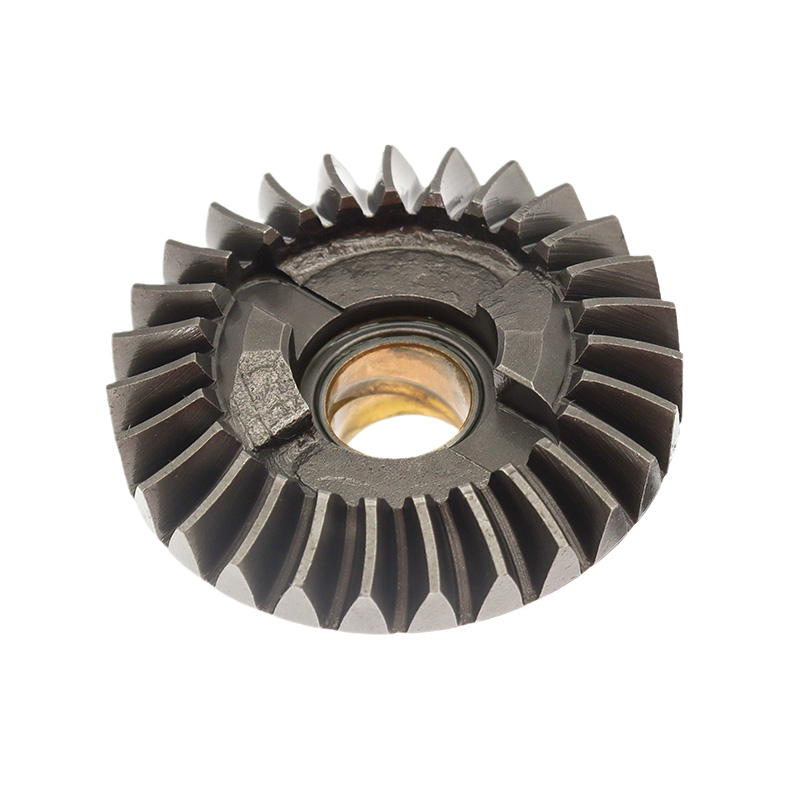
In involute gears, base pitch is the distance between corresponding points on the same flank of two adjacent teeth, measured along the base circle. For spur gears, this base pitch equals the circular pitch projected on the base circle; for helical gears, it can be defined in the transverse or normal plane depending on how the gear is specified. [files.engineering]
Because base pitch is measured along the base circle (the circle from which the involute tooth profile is generated), it directly governs how tooth flanks come into contact during rolling and sliding. If two mating gears do not share the same base pitch (within tolerance), you will see noise, vibration, tooth wear and, in outboard gearcases, early failure under high torque and shock loads. [chamolgear]
Marine and outboard gear systems run in a harsh environment: high torque at low speed during acceleration, shock loads from shifting, and corrosion risk from seawater. In this context, consistent base pitch is not just a textbook concept—it becomes a control parameter for reliability, noise and efficiency. [boatmarketingpros]
Key reasons base pitch is critical in outboard and marine gears:
- Smooth meshing under load – Equal base pitch between pinion and gear ensures that multiple teeth share the load, reducing peak stress on any single tooth. [chamolgear]
- NVH performance – Small base pitch errors show up directly as tonal gear whine and vibration, especially noticeable in high‑speed outboard transmissions. [chamolgear]
- Interchangeability and service – OEMs and aftermarket suppliers (like Ningbo Gill Transmission Parts) must control base pitch to guarantee that replacement gears mesh correctly with existing mating components. [pmc.ncbi.nlm.nih]
- Efficiency and heat – Poor base pitch matching increases sliding, friction and oil temperature inside the gearcase, which shortens oil life and seal life over time. [pmc.ncbi.nlm.nih]
In our own outboard gear production, we treat base pitch as one of the primary acceptance criteria alongside module, pressure angle and runout when validating new gear batches for marine customers. [pmc.ncbi.nlm.nih]
Before going deeper into base pitch, it helps to anchor a few basic gear terms used by marine and industrial gear manufacturers. [khkgears]
- The pitch circle is an imaginary circle on which gear motion is considered to roll without slip. [youtube]
- Circular pitch p is the arc distance along the pitch circle between a point on one tooth and the same point on the next tooth. [youtube]
- For a gear with pitch circle diameter d and number of teeth z circular pitch is:
p=πd/z
Circular pitch must be equal for two gears that mesh, which is why they must share the same module or diametral pitch standard. [scribd]
In metric systems, module m expresses tooth size and is defined as:
m=d/z
where d is in millimeters, so m also has millimeter units. [scribd]
A larger module means larger teeth and typically higher load capacity but also larger overall gear size—an important trade‑off in compact outboard gearcases where packaging is tight. [khkgears.co]
Every involute gear tooth is generated from a base circle, which is smaller than the pitch circle and determined by the pressure angle. The base circle diameter db is: [khkgears.co]
db=dcosα
where d is the pitch circle diameter and α is the pressure angle (commonly 20° in modern gear standards). [khkgears.co]
On this base circle, an involute curve is traced by unwrapping a taut string from the circle, and this involute defines the working flank of the tooth. Since base pitch is measured on the base circle between equivalent points on adjacent involutes, it is a direct descriptor of how the involute flanks are spaced around the gear. [files.engineering]
For a standard spur involute gear:
- Base pitch pb is the distance along the base circle between corresponding points on adjacent tooth flanks. [files.engineering]
- It can be related to circular pitch p by projecting onto the base circle:
pb=pcosα
where p is circular pitch on the pitch circle and α is the pressure angle. [files.engineering]
Using equations and together, base pitch can be written in terms of module m: [antikode]
pb=πmcosα
For helical gears, base pitch may be defined in the transverse or normal plane, depending on whether the module and pressure angle are given in transverse or normal form. This is especially important in marine gearboxes that use helical pinions to reduce noise. [scribd]
For two gears to mesh properly:
- Their circular pitches must be equal (same module and standard). [khkgears]
- Their base pitches must effectively match along the line of action, so that the contact line moves smoothly from one tooth pair to the next. [chamolgear]
In practice, that means:
- The pinion and gear must share the same module, pressure angle and tooth form standard. [khkgears.co]
- Manufacturing error in base pitch (tooth spacing error) must be kept within tight tolerances defined by the gear quality grade (e.g., ISO or AGMA classes). [id.scribd]
If base pitch differs between mating gears beyond allowable tolerance, the result is transmission error—variation in angular velocity—leading to audible whine, vibration, and increased tooth stress. In a high‑speed outboard drive where the propeller shaft may run at thousands of RPM, that error becomes very noticeable to the boat operator. [chamolgear]
To illustrate how base pitch shows up on the shop floor, consider a typical outboard final drive gear pair:
- Pinion: module 2.5, 20 teeth, pressure angle 20°
- Gear: module 2.5, 40 teeth, pressure angle 20°
From equation, the pitch circle diameters are: [linkedin]
- Pinion: d1=mz1=2.5×20=50mm
- Gear: d2=mz2=2.5×40=100 mm [scribd]
Using equation, circular pitch is: [antikode]
p=πd1/z1=π×50/20=7.854mm
Base pitch for both gears (they share m and α):
On the inspection bench, a base pitch measuring device (or a CNC gear measuring center) will check that the actual base pitch of both components stays within micrometer‑level tolerance around this nominal 7.38 mm, across all tooth spaces. This is exactly the sort of check our production team runs before gears move to heat treatment and final grinding in an outboard gear project. [id.scribd]
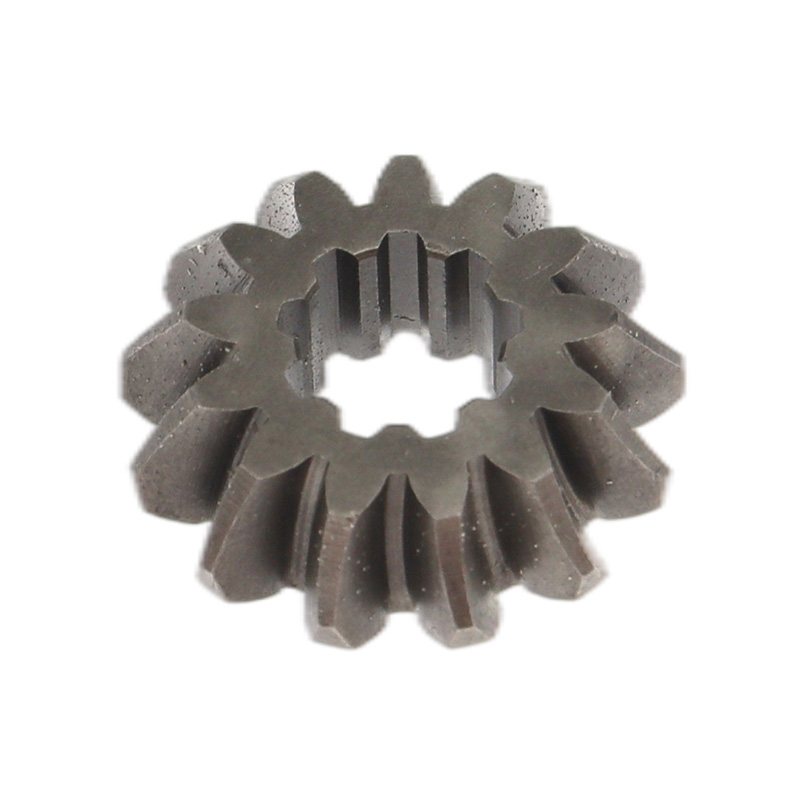
From both field feedback and QC data, several recurring issues can be traced back to base pitch and related tooth spacing errors. [pmc.ncbi.nlm.nih]
- Symptom: High‑pitched whine that peaks at a narrow RPM range under steady load.
- Likely cause: Systematic base pitch error or eccentricity, leading to periodic transmission error as teeth engage. [chamolgear]
- Impact: Customer dissatisfaction, warranty claims for "noisy gearcase," though gears may not yet show visible damage. [pmc.ncbi.nlm.nih]
- Symptom: Localized pitting along the tooth flanks, often on the drive side. [chamolgear]
- Likely cause: Poor load sharing between teeth because base pitch mismatch concentrates contact on fewer tooth pairs. [chamolgear]
- Impact: Reduced gear life, risk of surface fatigue propagating to flake‑off and eventual tooth breakage.
- Symptom: Harsh shifting into Forward/Reverse in dog‑clutch systems, sometimes with gear "clunk."
- Likely cause: Combined effect of tooth spacing error, misalignment and backlash issues, which show up strongly in the first contact region. [chamolgear]
- Impact: User perception of low quality; possible long‑term damage to dogs and mating gear faces.
In many of these cases, tightening base pitch tolerance and improving tooth spacing control is one of the most effective corrective actions, often ranking alongside improving heat treatment and surface finish in root cause analyses. [pmc.ncbi.nlm.nih]
From an E‑E‑A‑T perspective, one of the strongest signals you can send is to show concrete, real‑world practices. Here are steps we follow in our outboard gear projects to control base pitch: [wgcontent]
1. Standardize gear data
- Lock down module, pressure angle, helix angle (if any) and profile shift across all mating components before tooling design. [khkgears.co]
2. Use precision cutting tools and calibration
- Regularly calibrate hobs and grinding wheels, as even small wear changes effective tooth spacing. [id.scribd]
3. Measure base pitch statistically, not just spot‑check
- Use gear measuring machines to capture base pitch across all teeth and analyze Cp/Cpk for process stability. [id.scribd]
4. Correlate lab data with field noise and failure reports
- When a customer reports noise or pitting, we pull the batch's base pitch and spacing data to see how it correlates with the issue. [pmc.ncbi.nlm.nih]
5. Optimize heat treatment and grinding sequence
- Distortion during hardening can change practical base pitch, so we design the process to minimize distortion and refine tooth spacing in finish grinding. [id.scribd]
These are the sorts of process‑level controls that separate a generic gear supplier from a marine‑specialized partner who understands outboard gear durability.
If you are a marine OEM, designer, or maintenance engineer, you can use the following simple workflow to evaluate base pitch risk in your drivetrain:
1. Confirm design data
- Verify that both gears use the same module (or DP), pressure angle and tooth profile standard. [khkgears]
2. Calculate nominal base pitch
- From design data, use pb=πmcosα to get the theoretical base pitch for the pair. [files.engineering]
3. Review supplier inspection reports
- Ask your supplier for gear measurement charts, specifically base pitch or tooth spacing results per gear. [id.scribd]
4. Compare with gear quality standards
- Check that base pitch variation meets the target ISO or AGMA quality grade specified for your marine application. [id.scribd]
5. Correlate with NVH tests
- If you run on‑boat or dyno NVH tests, compare the worst‑case base pitch variation lots with the measured noise signatures. [pmc.ncbi.nlm.nih]
6. Loop feedback to design and sourcing
- Use these insights to update gear tolerances, supplier selection and acceptance criteria in your next model year. [innovationvisual]
By following a structured approach like this, marine brands can systematically reduce noise and failure risk tied to gear mesh quality.
While this article focuses on base pitch, real‑world outboard gear reliability depends on several interrelated factors: [scribd]
- Tooth size and module – Determines basic load capacity and packaging.
- Material and heat treatment – Governs strength, surface hardness and toughness in shock loading. [khkgears.co]
- Profile modifications – Adjustments such as tip relief that improve load distribution and reduce noise. [id.scribd]
- Alignment and bearing design – Misalignment can negate even perfect base pitch control by shifting contact patterns. [id.scribd]
Thinking of base pitch as one element in this system helps prevent oversimplification when troubleshooting marine drivetrain issues.
| Term | Definition (simplified) | Key formula or relation |
|---|---|---|
| Module mm | Tooth size in mm per tooth; main metric sizing unit | m=d/z |
| Pitch circle | Imaginary rolling circle defining gear motion | — |
| Circular pitch pp | Arc distance between identical points on adjacent teeth on pitch circle | p=πd/zyoutube |
| Base circle | Circle from which involute tooth flank is generated | db=dcosα |
| Base pitch pbpb | Distance along base circle between corresponding points on adjacent tooth flanks | pb=pcosαfiles.engineering |
If you design or source outboard and marine transmission components, controlling base pitch and related gear quality parameters is essential for quiet, reliable and efficient propulsion systems. As a dedicated manufacturer of outboard gears and marine drivetrain components, Ningbo Gill Transmission Parts Co., LTD. can support you from early gear specification and simulation through to mass production and quality verification. [boatmarketingpros]
To discuss your current gear challenges—or to review your existing gear drawings for base pitch and mesh alignment risks—get in touch with our engineering team and request a no‑obligation gear design and QC review for your next outboard project. [innovationvisual]
1. Is base pitch the same as circular pitch?
No. Circular pitch is measured along the pitch circle, while base pitch is measured along the base circle; they are related by \(p_b = p \cos \alpha\). [files.engineering]
2. Why is base pitch so important in outboard gearboxes?
Because even small base pitch errors create transmission error, which shows up as gear whine, vibration and early tooth wear in high‑speed marine drives. [chamolgear]
3. Can I mix gears with the same module but different pressure angles?
No. Even if the module and tooth count "fit," different pressure angles change the base circle and base pitch, leading to poor or unsafe meshing. [khkgears]
4. How do I know if my supplier is controlling base pitch properly?
Ask for gear measurement reports that include tooth spacing or base pitch data and compare them with your specified ISO/AGMA quality grade tolerances. [id.scribd]
5. Does base pitch matter for small hobby or low‑power marine applications?
Yes. While tolerances can be slightly more relaxed, inconsistent base pitch still causes noise and wear, especially at higher speeds and with long operating hours. [pmc.ncbi.nlm.nih]
1. Chamol Gear. "Spur Gear Pitch Basic Guide – Base Pitch Definition." [Link]. [chamolgear]
2. KHK Gears. "Gear Module – KHK Gear Manufacturer." [Link]. [scribd]
3. KHK Gears. "Circular Pitch | Gear Nomenclature." [Link]. [khkgears]
4. KHK Gears. "Basic Gear Terminology and Calculation." [Link]. [id.scribd]
5. Kohara Gear Industry Co., Ltd. "Introduction to Gears – Technical Reference." [Link]. [khkgears.co]
6. Engineering.com. "Base Pitch Tables." [Link]. [files.engineering]
7. WG Content. "E‑E‑A‑T for Content Quality and GEO." [Link]. [wgcontent]
8. Innovation Visual. "Google's EEAT Guidelines – How To Remain Compliant." [Link]. [innovationvisual]
9. PMC. "Search engine optimisation (SEO) strategy as determinants to …" [Link]. [pmc.ncbi.nlm.nih]
10. Boat Marketing Pros. "SEO Explained for Marine Businesses." [Link]. [boatmarketingpros]


