


close
Choose Your Site
Global
Social Media
Views: 222 Author: Gill Transmission Publish Time: 2026-04-11 Origin: Site


When you design or select outboard gears for marine applications, getting the basic gear terminology and calculations right is the difference between a quiet, efficient drivetrain and a costly warranty claim at sea. Drawing on years of working with marine transmission parts and feedback from boat OEMs, I'll walk through the essential terms, formulas, and practical decision points you actually use when specifying gears for outboard engines and related marine systems. [tiecas]
For outboard engines and stern drives, gear terminology is not just academic vocabulary; it's engineering shorthand that directly affects durability, vibration, and noise in the water. When a design engineer and a machinist share a clear definition of module, pressure angle, and backlash, they avoid mismatched parts and unexpected tooth failure during sea trials. [gearsolutions]
From an OEM's perspective, mastering basic gear calculation also shortens design cycles: you can quickly evaluate alternative gear ratios, center distances, and tooth profiles before committing to tooling. [gearsolutions]
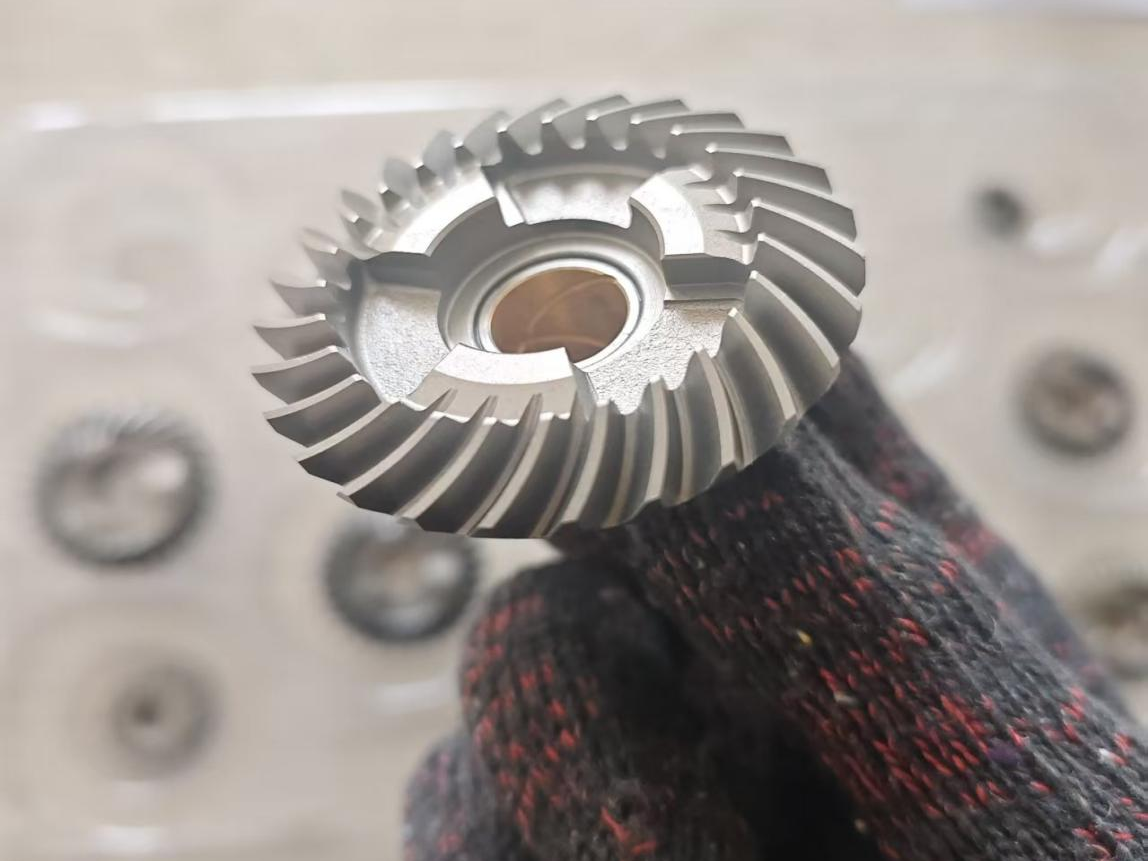
- Pitch circle: The imaginary circle where two mating gears effectively "roll" against each other without slipping. [khkgears.co]
- Module (m): Metric measure of tooth size, defined as
m=d/z
where d is the pitch circle diameter and z is the number of teeth. [khkgears.co]
For outboard gears, choosing a larger module improves load-carrying capacity but increases size and weight, which matters when packaging in compact gearcases. [gearsolutions]
- Pressure angle (α): Angle between the line of action and a line tangent to the pitch circle. [khkgears.co]
- Common values are 20° and 25° for many industrial gears; in high-load marine drives, higher pressure angles can improve strength but increase radial load on bearings. [khkgears.co]
- Face width (b): Width of the tooth along the gear axis (for spur) or along the tooth face (for bevel). [khkgears.co]
- Increasing face width raises permissible torque, but excessive width without proper alignment invites uneven contact and edge loading. [gearsolutions]
Different gear types are used inside and around outboard engines, each with specific roles. [khkgears]
| Gear type | Typical marine use | Key characteristics |
|---|---|---|
| Spur gear | Starter motors, accessory drives | Straight teeth, simple to manufacture, noisy at high speed (khkgears.co) |
| Helical gear | Auxiliary marine gearboxes, high-speed pumps | Angled teeth, quieter, generates axial thrust (khkgears.co) |
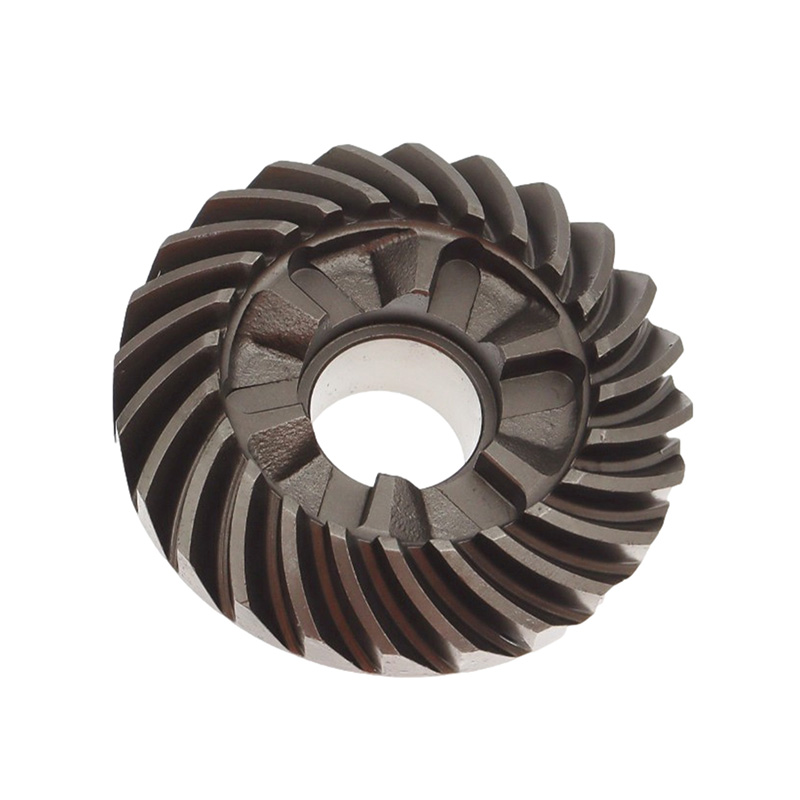
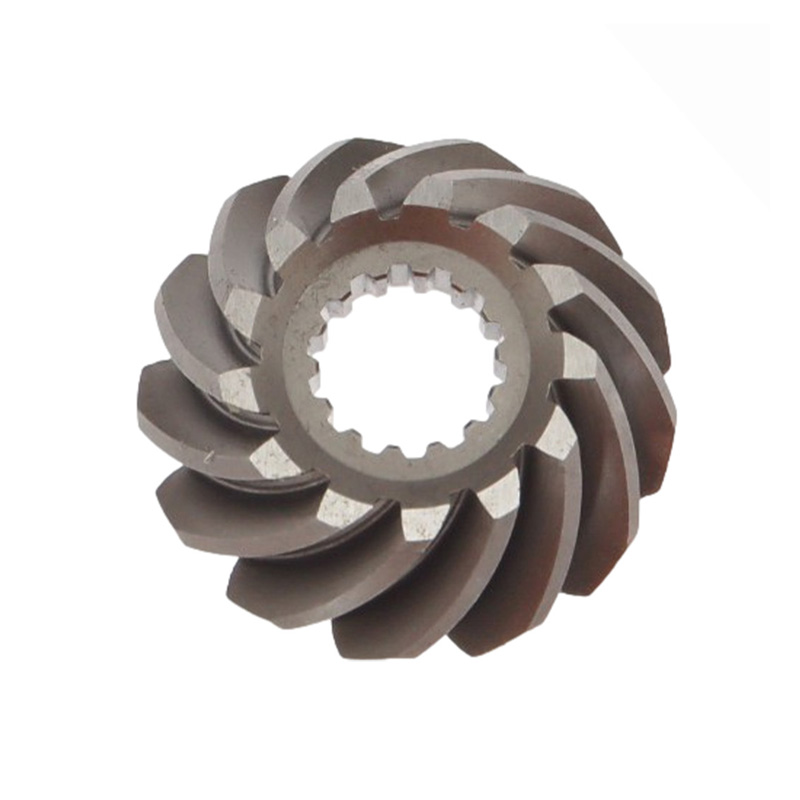
| Bevel gear | Outboard and stern drive direction change (90°) | Conical shape, transmits motion between intersecting shafts (khkgears) |
| Spiral bevel | High-performance outboard gear sets | Curved teeth, smoother engagement, complex manufacturing (gearsolutions) |
For most outboard lower units, the critical components are spiral bevel or hypoid-style gears that transfer torque from the vertical driveshaft to the horizontal propeller shaft. [gearsolutions]
The simplest and most important parameter is the gear ratio, defined as:
i=z2/z1
where z1 is teeth on the pinion (driver) and z2 is teeth on the gear (driven). [khkgears.co]
Example from an outboard drive:
- Pinion: 13 teeth
- Propeller shaft gear: 26 teeth
- Gear ratio: i=13/26=2.0 (2:1 reduction)
This means the propeller shaft turns once for every two turns of the crankshaft, which helps move a heavy boat efficiently at low engine speed. [gearsolutions]
For spur or helical gears with the same module and pressure angle, the center distance is
a=(d1+d2)/2=(z1+z2)/2m
If you increase the gear ratio while keeping center distance fixed, you must adjust the tooth numbers and sometimes profile shift to maintain proper meshing. [khkgears.co]
Because outboard lower units rely on bevel or spiral bevel gears, specific terminology matters. [khkgears]
Key terms:
- Pitch cone angle: Angle between the shaft axis and the pitch cone surface. [khkgears]
- Back cone distance: Distance from apex of the pitch cone to the back face of the gear, useful for mounting calculations. [khkgears]
- Face angle: Angle that defines tooth face extent along the cone; affects load capacity and contact stability. [khkgears]
In a typical outboard design, one bevel pinion on the vertical shaft meshes with forward and reverse gears on the propeller shaft, engaging via a dog clutch. Precise control of pitch cone angle and mounting distance is critical to avoid noisy operation and premature pitting under varying propeller loads. [gearsolutions]
From a manufacturing and design standpoint, here is a simplified workflow I often use when working with OEMs on small to mid‑power outboard gears.
1. Define operating requirements
- Engine power and max RPM
- Target boat speed and propeller characteristics
- Required service life and noise constraints in typical marine conditions [tiecas]
2. Choose gear type and ratio
- Spiral bevel for the 90° direction change in the lower unit
- Gear ratio in the 1.8:1 to 2.3:1 range for many recreational outboards, tuned to hull type and propeller. [gearsolutions]
3. Select module and tooth counts
- Start with module based on torque and available space
- Pick tooth numbers to avoid undercut and resonance (e.g., avoid very low tooth counts on the pinion) while meeting center distance constraints. [khkgears.co]
4. Calculate center distance and mounting geometry
- Use standard formulas for pitch diameters and center distances
- Adjust face width, pressure angle, and profile shift to balance strength and noise. [khkgears.co]
5. Validate with simulation and sea testing
- Conduct contact pattern analysis and load distribution checks
- Confirm that real‑world noise and vibration match expectations across propeller loads and cavitation events. [gearsolutions]
Below are core formulas regularly used in marine gear projects. [khkgears.co]
Pitch circle diameter: d=m⋅z
Addendum (standard): a=m
Dedendum (standard): b≈1.25m
Outside diameter: da=d+2a=m(z+2)
Root diameter: df=d−2b
For torque capacity, engineers often approximate the permissible tangential force Ft on a spur or bevel gear tooth as proportional to
Ft∝σallow⋅b⋅m
where σallow is the allowable tooth bending stress based on material, heat treatment, and desired safety factor. [gearsolutions]
In outboard designs, this tangential force must be checked against operating torque, including transient overloads due to wave impacts and fast throttle changes. [gearsolutions]
From field feedback and teardown analysis in marine workshops, several recurring issues appear in outboard gears:
- Pitting and spalling on the drive side of bevel gear teeth due to underestimated contact stress or insufficient lubrication. [gearsolutions]
- Noise and whine at certain RPM bands from improper tooth contact patterns or inaccurate mounting distance. [gearsolutions]
- Premature bearing failure caused by overlooking the radial and axial forces induced by higher pressure angle or helical geometry. [khkgears.co]
When teams have a shared and precise vocabulary—face width, contact ratio, mounting distance, profile shift—they can systematically diagnose and prevent these problems instead of relying on trial‑and‑error adjustments. [tiecas]
Suggested visual here:
- Macro photos or diagrams of tooth pitting, edge contact, and ideal contact pattern on a spiral bevel gear tooth. [elvtr]
If you are sourcing outboard gears or marine transmission components rather than designing them from scratch, here are specifications to clarify with your supplier:
- Exact gear ratio and tolerance
- Required module, pressure angle, and standard (e.g., metric involute)
- Gear type (spiral bevel, straight bevel, spur, helical) and shaft arrangement
- Target torque, peak overload, and safety factor expectations
- Surface hardness, core hardness, and coating or corrosion protection strategy for marine environments [tiecas]
A supplier specialized in marine gear sets should also provide traceable material certificates, dimensional inspection reports, and pattern check data for bevel gears. This evidence supports long‑term reliability and aligns with modern expectations for manufacturing in industrial sectors. [parashifttech]
Despite the value of formulas and terminology, real‑world outboard gear design involves compromises across hydrodynamics, NVH (noise, vibration, harshness), and manufacturability. It's wise to involve a supplier's application engineer when: [tiecas]
- You are increasing engine power or RPM beyond earlier models
- You are shifting from straight bevel to spiral bevel for noise control
- You need to repackage the lower unit and change center distances or shaft geometry
- You have recurring field failures with no clear root cause
An experienced partner will reference the same terms—module, pressure angle, face width, mounting distance—but combine them with test data and production know‑how to recommend robust gear solutions for your specific marine platform. [parashifttech]
If you are working on a new outboard gear project or trying to solve chronic lower unit failures, build on this basic gear terminology and calculation foundation, then partner with a marine-focused gear manufacturer that can validate your concepts through design support and testing. Share your target power range, gear ratio, geometry constraints, and environmental conditions, and request a proposal that includes detailed gear drawings, material specs, and validation plans tailored to marine use. [parashifttech]
1. Why are bevel gears so common in outboard engines?
Bevel and spiral bevel gears efficiently transmit power between intersecting shafts—typically the vertical driveshaft and horizontal propeller shaft—while fitting inside a compact, hydrodynamically shaped gearcase. They also allow designers to tune tooth geometry for lower noise and smoother load transfer compared with simple spur gears in a right‑angle configuration. [khkgears]
2. What gear ratio should I choose for a small recreational outboard?
There is no single best ratio, but many small recreational outboards operate in roughly the 1.8:1 to 2.3:1 range, depending on engine characteristics and hull type. Final selection should be based on propeller matching, target boat speed, and engine torque curves validated by testing. [gearsolutions]
3. How does pressure angle affect outboard gear performance?
Higher pressure angles typically increase tooth strength and reduce sliding, which can help with high torque in compact marine gearsets. However, they also raise radial forces on bearings, so designers must balance durability, noise, and bearing life in the outboard lower unit. [khkgears.co]
4. What are common failure modes of outboard gears?
Typical failures include pitting, spalling, tooth breakage, and excessive noise due to poor contact patterns or misalignment under load. These are often linked to under‑designed tooth geometry, inadequate lubrication, or manufacturing deviations in pitch, profile, and mounting distance. [gearsolutions]
5. How can I verify the quality of purchased outboard gears?
Request dimensional inspection reports, hardness profiles, and contact-pattern checks, especially for bevel and spiral bevel gears. Field monitoring of noise, vibration, and oil condition in the lower unit also provides practical confirmation of gear quality in service. [parashifttech]
1. Marine industrial blogging and UX best practices for technical audiences. [tiecas]
https://www.tiecas.com/guide-to-writing-industrial-blogs/
2. On-page SEO essentials for marine businesses and keyword placement guidance. [digitaldeckhand]
https://digitaldeckhand.com/on-page-seo-essentials-for-marine-businesses/
3. SEO strategies and structured content for boat and marine manufacturers. [seaitapp]
https://seaitapp.com/from-leads-to-loyal-customers-building-a-customer-retention-strategy-for-boat-dealers/
4. E‑E‑A‑T in manufacturing SEO and the role of expert, experience-rich content. [parashifttech]
https://www.parashifttech.com/blog/stand-out-in-manufacturing-seo-using-e-e-a-t-to-build-real-online-trust-and-growth
5. Fundamentals of gear design, terminology, and geometry in industrial applications. [khkgears.co]
https://www.khkgears.co.jp/gear_technology/gear_reference/KHK500_2_1.html
6. Advanced approaches to optimal gear design and early-stage performance prediction. [gearsolutions]
https://gearsolutions.com/features/an-advanced-approach-to-optimal-gear-design/
7. Visual best practices for using diagrams and graphics to explain complex data. [elvtr]
https://elvtr.com/blog/7-best-practices-tips-to-make-your-data-visualization-more-engaging


