


close
Choose Your Site
Global
Social Media
Views: 222 Author: Gill Transmission Publish Time: 2026-05-30 Origin: Site


Content Menu
● What Is Gear Center Distance?
● Why Center Distance Matters in Outboard Gears
● Basic Formulas for Center Distance
>> Diametral pitch gears (imperial)
● Theoretical vs. Actual Center Distance
● Backlash and Center Distance
● Practical Design Example (Outboard Gear Pair)
● Center Distance in Marine Gearboxes: Expert Considerations
>> Bearing and shaft deflection
● How Center Distance Affects Noise and Efficiency
● Simple Center Distance Design Workflow
● Using Center Distance Calculators and Software
● Center Distance Tolerances and Manufacturing
● Application Example: Outboard Lower Unit (Conceptual)
● Key Formulas for Center Distance
● When to Consult a Gear Specialist
● Call to Action: Get Engineering Support for Your Outboard Gears
● Frequently Asked Questions (FAQ)
Designing reliable outboard gearboxes starts with getting gear center distance right. A small error in center distance can mean noisy operation, premature wear, or even catastrophic failure in marine environments. [firgelliauto]
In this guide, I will explain center distance from the perspective of a marine transmission engineer, show the formulas you actually use in design, and share practical tips based on real-world applications in outboard gears and marine drivetrains. You can apply the same principles to spur gears in industrial machinery, but the examples will focus on boat propulsion systems where reliability is non-negotiable. [khkgears]
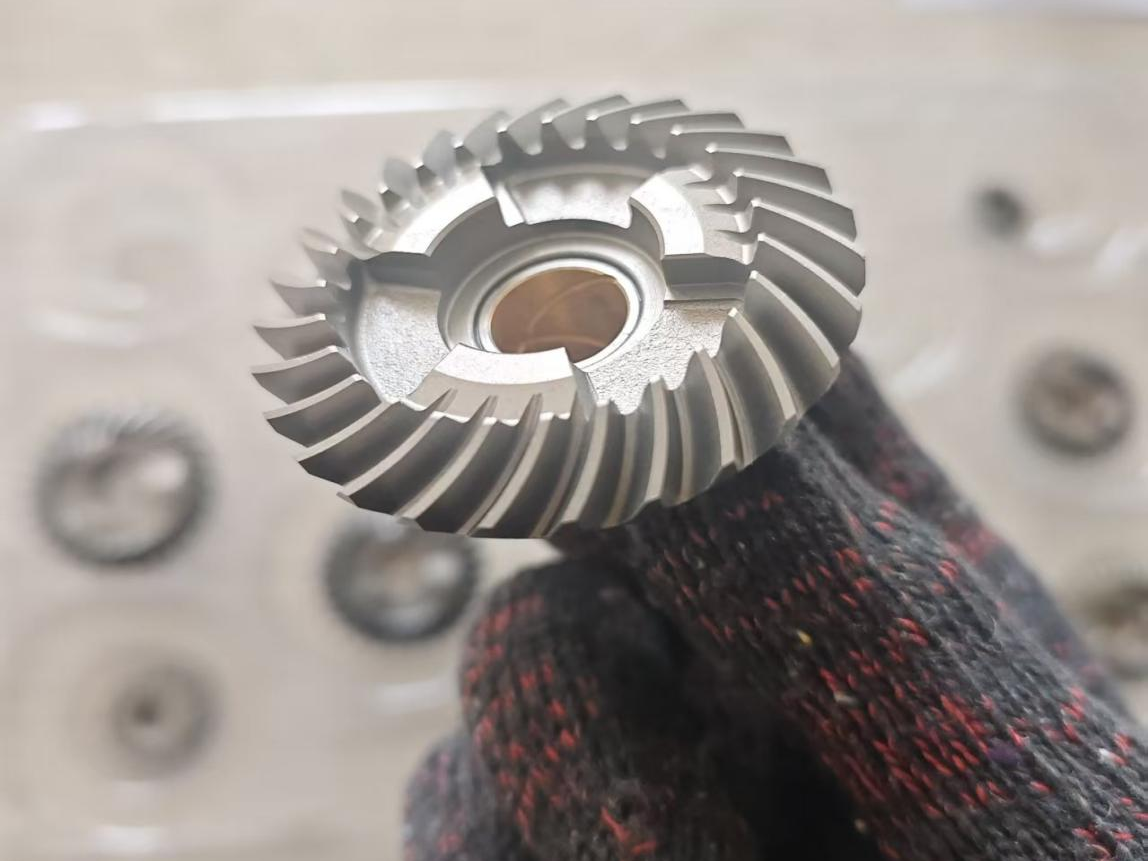
Gear center distance is the distance between the centers of two meshing gears mounted on parallel shafts. It is typically measured between the centers of the pitch circles of each gear. [khkgears]
In a spur gear pair:
- Let Gear A have pitch diameter dA
- Let Gear B have pitch diameter dB
Then the theoretical center distance is:
C=(dA+dB)/2[khkgears]
This simple expression is the starting point for all accurate gear spacing and housing design. [khkgears]
For outboard engines and marine gearboxes, correct center distance is directly linked to: [firgelliauto]
- Smooth torque transmission under variable load and shock.
- Low noise and vibration, especially at mid–high RPM cruising speeds.
- Gear tooth life under saltwater, contamination, and boundary lubrication.
- Backlash control, which affects shifting feel, rattling, and precision.
If the center distance is too small, the gears mesh too tightly. This causes: [khkgears]
- Excessive tooth contact stress
- Increased friction and temperature rise
- Risk of scoring or pitting
If the center distance is too large, the gears mesh too loosely: [chiefdelphi]
- Backlash becomes excessive
- Contact ratios fall, increasing noise and dynamic load
- Tooth tips may impact instead of rolling smoothly
In marine applications, with cavitation, load shocks from wave impacts, and frequent shifting, these problems accelerate dramatically. That is why careful calculation and controlled modification of center distance is a core part of our design work at Ningbo Gill Transmission Parts Co., LTD. [firgelliauto]
For metric spur gears (using module m and tooth counts N1 and N2) the standard formula is: [firgelliauto]
C=[(N1+N2)×m]/2
Here:
- N1, N2: Number of teeth on each gear
- m: Normal module (mm)
- C: Center distance (mm)
For inch-based spur gears defined by diametral pitch \(DP\): [chiefdelphi]
C=(PN1+N2)/(2×D)
Where:
- N1, N2: Gear tooth counts
- DP: Diametral pitch (teeth per inch)
- C: Center distance (inch)
These equations are the same as using pitch diameters directly and then dividing by two. [chiefdelphi]
In real gearboxes—especially compact outboard drives—the actual center distance is rarely exactly equal to the pure theoretical value. [chiefdelphi]
Engineers adjust center distance to: [brightedge]
- Compensate for manufacturing tolerances of gears and housings
- Achieve a target backlash range
- Reuse existing housing designs with new gear sets
- Allow for thermal expansion and bearing clearances
A common practice in industrial applications is to add a small spacing allowance beyond the exact theoretical value, sometimes on the order of a few hundredths of a millimeter for small-module gears, or a few thousandths of an inch in imperial systems. [chiefdelphi]
This practical center distance is sometimes called:
- "Mounting distance"
- "Adjusted center distance"
- "Effective center distance"
Backlash is the small clearance between mating gear teeth, measured along the pitch circle. It ensures that gears do not jam under load or due to manufacturing deviations. [khkgears]
Key relationships:
- Increasing center distance increases backlash
- Decreasing center distance reduces backlash
Marine gear designers aim for a backlash that: [firgelliauto]
- Prevents binding at maximum load and temperature
- Limits gear rattle during low-load idle
- Maintains acceptable noise at cruising speed
In outboard lower units, backlash targets can be tighter than in some industrial gearboxes, due to noise and feel expectations of boat owners. At the same time, the environment (water intrusion, misalignment from impacts) forces us to avoid ultra-tight clearances.
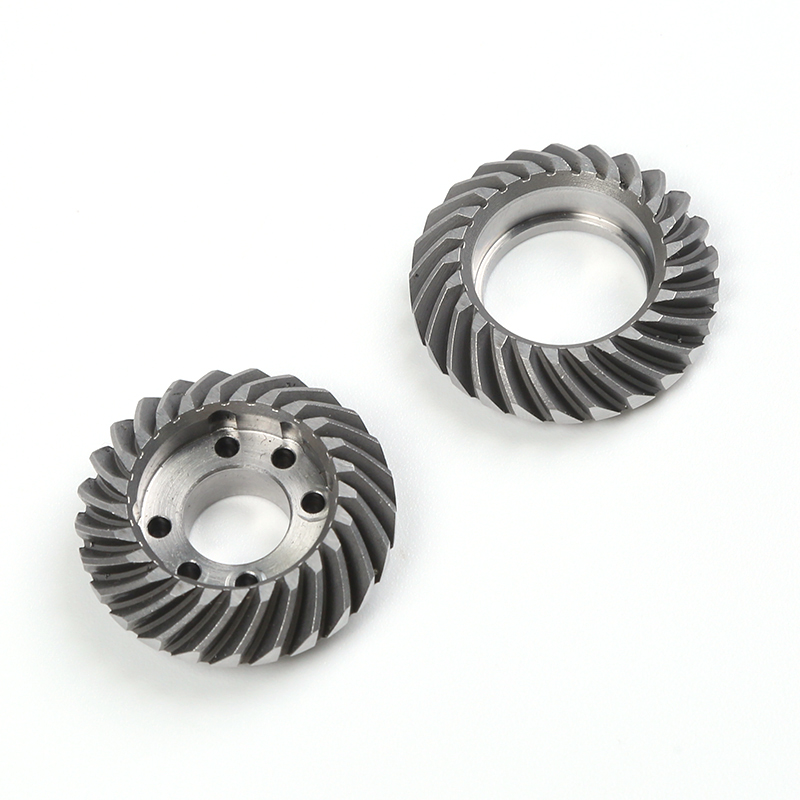
Consider a simple outboard gear pair in the reduction stage:
- Gear 1 (input pinion): N1 = 18 teeth, module m = 2.5 mm
- Gear 2 (output gear): N2 = 36 teeth, module m = 2.5 mm
Step 1 – Theoretical center distance
Ctheoretical=[(18+36)×2.5]/2=254×2.5=135/2=67.5mm [firgelliauto]
Step 2 – Adjusting for backlash and tolerances
Based on housing and gear tolerances, as well as desired backlash, we might: [brightedge]
- Start with 67.5 mm
- Add a small positive adjustment (for example +0.02 to +0.05 mm)
- Define a production tolerance range (e.g., 67.52–67.55 mm)
We then verify the result with:
- Gear contact pattern checks
- Noise and vibration testing on a dynamometer
- Endurance testing in salt-spray and load cycles
From real marine projects, there are several center distance pitfalls that do not always appear in textbooks. [firgelliauto]
Under load, shafts bend and bearings deform, effectively altering center distance and mesh alignment. In outboard drives, long slim shafts and highly loaded spiral bevel gear stages can magnify this effect. [khkgears]
Design responses include:
- Choosing bearing types and preloads to minimize deflection
- Designing housings with sufficient stiffness
- Setting a slightly tighter initial center distance, knowing it will "open up" under load
Gear housings, shafts, and gears expand with temperature. In an outboard unit:
- The gear oil warms during operation
- The housing may be cooled externally by water, creating gradients
Material selection (e.g., aluminum housings with steel shafts) must be considered when deciding nominal center distance. [khkgears]
Marine environments cause:
- Corrosion pits on teeth
- Wear in bearings
- Fretting in fits
All of these can subtly change effective center distance and backlash over time. Designing a robust center distance and backlash window helps maintain acceptable performance throughout the gearbox life.
Noise and efficiency are primary performance metrics for outboard transmissions. [khkgears]
- A center distance that is too small increases sliding, friction, and heating, causing efficiency loss and whining noise.
- A center distance that is too large can reduce contact ratio so fewer teeth share the load, which increases dynamic force and noise. [khkgears]
Optimized center distance and backlash, combined with proper tooth profile modifications, typically deliver:
- Higher efficiency under steady load
- Reduced whine at cruising RPM
- Improved durability of tooth flanks [khkgears]
These are crucial in competitive marine markets where end users compare not just top speed but also refinement and maintenance costs.
For many outboard gear projects, we follow a repeatable workflow:
1. Define gear ratio and space envelope
- Based on power, desired propeller speed, and housing constraints.
2. Select module (or diametral pitch) and tooth numbers
- Use standard module values and balanced tooth counts. [firgelliauto]
3. Calculate theoretical center distance
- Using the module or diametral pitch formulas. [chiefdelphi]
4. Estimate adjustments for backlash and tolerances
- Based on experience, gear quality, and housing machining capability. [brightedge]
5. Prototype and test
- Check contact pattern, noise, temperature, and durability.
6. Refine center distance and housing tolerances
- Iterate until performance and manufacturability targets are met.
This structured approach reduces trial-and-error and shortens development time for new outboard gear sets.
Today, most engineers use gear design software or web-based calculators to validate center distance and related parameters. [firgelliauto]
Typical capabilities include: [firgelliauto]
- Automatic center distance calculation from tooth counts and module/DP
- Backlash estimation
- Pitch diameters and contact ratio calculation
- Metric/imperial conversion
These tools are especially useful when:
- Comparing different gear ratios within the same housing
- Evaluating center distance change impacts on backlash and tooth contact
However, the final decision for center distance in marine transmissions should always be validated against physical testing in representative conditions.
From a manufacturing perspective, holding tight center distance tolerances in a marine gearbox can be challenging and expensive. [bruceclay]
Important considerations:
- Machining strategy – Boring both bearing seats in a single setup improves consistency.
- Datum structure – Clear datums in drawings help suppliers control key dimensions.
- Quality level – Gear and housing tolerances must be specified to match target backlash windows.
When we design outboard gears at Ningbo Gill Transmission Parts Co., LTD., we work closely with machining partners to match realistic CNC capabilities with gear quality requirements, ensuring that center distance is controlled economically across batches.
In a typical outboard lower unit, there can be: [khkgears]
- A vertical drive shaft from the powerhead
- A bevel or hypoid gear pair turning direction towards the propeller shaft
- Additional spur or helical gear stages for fine tuning the ratio
Each of these gear pairs has its own center distance and backlash range. Design trade-offs include:
- Keeping the housing compact for hydrodynamics
- Allowing enough center distance for acceptable bearing sizes
- Maintaining robust backlash even with shaft deflection and assembly tolerances
Achieving all of this requires not just calculating center distance but engineering around it—optimizing housing design, bearings, materials, and assembly processes.
| Gear system | Known values | Center distance formula |
|---|---|---|
| Metric (module) | N1,N2,m | C=(N1+N2)×m/2(firgelliauto) |
| Imperial (DP) | N1,N2,DP | C=(N1+N2)/(2×DP)(chiefdelphi) |
| Pitch diameters | dA,dB | C=(dA+dB)/2(khkgears) |
Even with clear formulas, you should involve an experienced gear or marine transmission engineer when: [bruceclay]
- Power levels are high relative to gear size
- The housing is extremely compact
- There are stringent noise and vibration limits
- You must reuse an existing housing with new gear ratios
A specialist can help evaluate profile modifications, load distribution, and test data, ensuring that your chosen center distance is safe and economical.
If you are designing or sourcing outboard gears, propeller shaft gears, or marine transmission components, our engineering team at Ningbo Gill Transmission Parts Co., LTD. can support you from concept to production, including center distance optimization and housing design review.
If you are planning a new marine drivetrain project or optimizing an existing outboard gearbox, you do not have to solve center distance and backlash challenges alone.
- Share your target power, ratio, and space constraints
- We can propose gear geometry, center distance, and housing recommendations
- We also provide custom outboard gear sets manufactured to marine-grade standards
Contact Ningbo Gill Transmission Parts Co., LTD. to discuss your application and receive an engineering-backed proposal tailored to your gearbox design.
Q1: What is the simplest way to calculate center distance for two spur gears?
For metric gears, add the tooth counts, multiply by the module, and divide by two: C = (N1 + N2) × m / 2. [firgelliauto]
Q2: Can I reuse an existing housing with a new gear ratio?
Often yes, but you must verify that the new tooth counts and module produce a center distance compatible with existing bearing and housing geometry, and still achieve acceptable backlash. [khkgears]
Q3: How does center distance affect gear noise in outboard engines?
If center distance is too small, gears run tight and noisy; too large, contact ratio falls and dynamic loads increase, also raising noise. The optimal center distance balances contact, backlash, and deflection. [khkgears]
Q4: Should I rely only on software for center distance decisions?
No. Software is excellent for initial design, but in marine applications you must validate center distance with physical tests under realistic load, temperature, and lubrication conditions. [brightedge]
Q5: What information should I provide to a gear supplier when asking for center distance advice?
Share gear ratio, power, speed, space constraints, expected duty cycle, noise requirements, and whether you must fit an existing housing. This allows engineers to recommend a safe and manufacturable center distance. [bruceclay]
1. KHK Gears – "Center Distance | Gear Nomenclature" (original concept source for center distance discussion)
https://khkgears.net/new/gear_knowledge/gear-nomenclature/center-distance.html
2. KHK Gears – "Gear Efficiency | Gear Nomenclature"
https://khkgears.net/new/gear_knowledge/gear-nomenclature/gear-efficiency.html [khkgears]
3. KHK USA – "Exploring the Hows and Whys of Choosing the Proper Center Distance" (PDF)
https://khkgears.us/media/wwkhaq04/gear-solutions_khk_exploring-the-hows-and-whys-of-choosing-the-proper-center-distance.pdf [khkgears]
4. FIRGELLI Automations – "Spur Gear Center Distance Calculator"
https://www.firgelliauto.com/blogs/engineering-calculators/spur-gear-center-distance-calculator [firgelliauto]
5. Chief Delphi – "Gear spacing – Technical Discussion"
https://www.chiefdelphi.com/t/gear-spacing/165836 [chiefdelphi]
6. BrightEdge – "E-E-A-T Implementation for AI Search" (guidance on experience, expertise, authoritativeness, trustworthiness)
https://www.brightedge.com/blog/e-e-a-t-implementation-ai-search [brightedge]
7. Bruce Clay – "6 Steps to Boost Your E-E-A-T Factor This Year"
https://www.bruceclay.com/blog/6-steps-to-boost-your-e-e-a-t-factor-this-year/ [bruceclay]


