


close
Choose Your Site
Global
Social Media
Views: 237 Author: Gill Transmission Parts Publish Time: 2026-10-14 Origin: Site


Content Menu
● Why Some Nissan Parts Fit Mercury Outboards
>> The Nissan–Tohatsu relationship
>> Where Mercury enters the picture
● Which Nissan Outboard Parts Might Fit Mercury?
● Why Matching Horsepower Is Not Enough
● How to Check Nissan-to-Mercury Parts Compatibility
>> Step 1: Identify the Mercury engine first
>> Step 2: Record the complete Mercury part number
>> Step 3: Identify the corresponding Nissan or Tohatsu component
>> Step 4: Confirm a documented cross-reference
>> Step 5: Check physical and assembly requirements
>> Step 6: Follow the applicable service procedure
● Nissan and Mercury Outboard Gears: Why Fitment Needs Greater Scrutiny
>> Dimensional similarity is only the starting point
>> Backlash and shimming are application-specific
>> A replacement gear should not hide a larger problem
● Three Common Compatibility Scenarios
>> Scenario 1: A documented service-part equivalent
>> Scenario 2: A visually similar gear without a cross-reference
>> Scenario 3: A confirmed cross-reference with a replacement-number change
● A Better Purchasing Standard for Dealers and Repair Businesses
● Get a Focused Outboard Gear Compatibility Review
>> Do Nissan parts fit all Mercury outboards?
>> Are Nissan and Tohatsu outboard parts interchangeable?
>> Can I use Nissan gears in a Mercury lower unit?
>> Do interchangeable parts always have identical numbers?
>> Is the serial number more useful than the engine year?
>> Can I use another engine's backlash specification?
Do Nissan parts fit Mercury outboard motors? Sometimes—but only when the exact component is confirmed for the specific Mercury engine. Nissan Marine outboards were manufactured by Tohatsu, and some Mercury outboards also came from Tohatsu-built platforms. That connection creates genuine opportunities for parts interchangeability, but it does not make every Nissan component a Mercury replacement.
At Ningbo Gill Transmission Parts Co., LTD., our perspective comes from 29 years of experience in developing, manufacturing, and selling outboard gears and other marine components. For us, compatibility means more than whether a part slides onto a shaft. It means whether that component meets the dimensional, functional, and installation requirements of the intended assembly.
This guide explains the brand relationship, how to verify replacement parts, and why lower-unit gears require particularly careful evaluation.
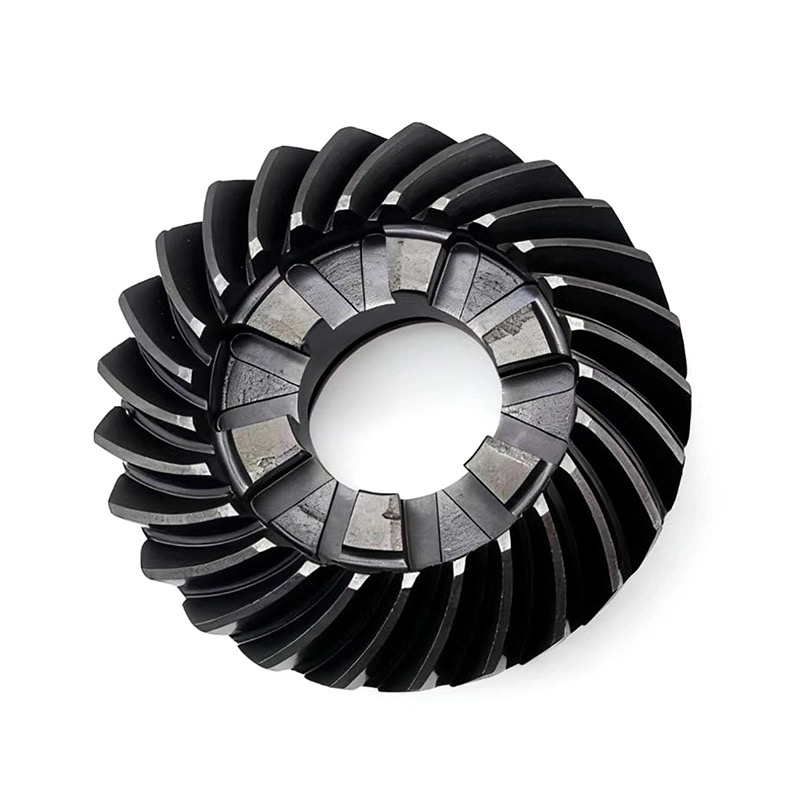
Nissan Marine's own website states that its outboards were manufactured by Tohatsu. It also directs owners toward Tohatsu parts, accessories, and technical support after Nissan discontinued outboard sales.
That makes corresponding Tohatsu catalogs a useful starting point when identifying Nissan outboard components. However, owners must still select the correct model and production range.
Catalog guidance also identifies brand-specific exceptions, including certain cowlings and decals. A shared mechanical platform does not necessarily mean every visible or packaged component is identical.
Tohatsu Marine was established in February 1988 as a joint venture between Tohatsu Corporation and Brunswick Corporation, Mercury Marine's parent company.
This manufacturing relationship explains why some Mercury and Tohatsu components have documented equivalents. MarineEngine's cross-reference resource explicitly notes that some Mercury models were manufactured by Tohatsu and that the same component may carry different brand part numbers.
The important distinction is:
- Nissan-to-Tohatsu compatibility follows the relevant Nissan/Tohatsu application.
- Tohatsu-to-Mercury compatibility requires a documented equivalent for the particular component.
- Nissan-to-Mercury compatibility must connect both applications—not merely the brand names.
Manufacturing history provides a reason to investigate compatibility, not permission to assume it.
A useful approach is to separate potentially interchangeable components from parts that demand more extensive verification.
| Component category | Why interchange may be possible | What must be verified |
|---|---|---|
| Water-pump components | Some shared applications have documented replacements | Exact part number, housing, key, and kit contents |
| Starter motors | Cross-reference catalogs list certain equivalents | Application, mounting, engagement, and electrical specification |
| Driveshafts | Some specific shafts appear in cross-reference listings | Shaft length, splines, bearing locations, and production range |
| Propellers | Certain individual propellers have listed equivalents | Application, hub arrangement, dimensions, and clearance |
| Gaskets and seals | Related assemblies may use equivalent components | Exact location, dimensions, and intended application |
| Forward, reverse, and pinion gears | Shared assemblies may create replacement opportunities | Gear geometry, interfaces, associated parts, and setup requirements |
| Cowlings and branded components | Mechanical platforms may be related | Attachment details and brand-specific catalog exceptions |
This table is a verification guide, not a universal fitment chart.
For example, finding one interchangeable impeller does not establish that the complete water-pump kit, gearcase, or driveshaft also interchanges. Treat each component as a separate purchasing decision.
A listing described as "fits Nissan and Mercury 9.9 HP" may sound convincing. However, horsepower alone does not identify the engine family, production revision, or component assembly.
Two engines with the same rated output may have different configurations. Parts catalogs therefore use model information and serial-number ranges to distinguish applications.
Before comparing Nissan and Mercury replacement parts, collect:
- Complete engine model identification.
- Engine serial number.
- Two-stroke or four-stroke configuration.
- Shaft-length designation.
- Starting and control configuration, where relevant.
- Original part number from the correct diagram.
- Any documented replacement or superseded number.
Mercury recommends searching its parts catalog by serial number. Its catalog guidance identifies the transom bracket as the location of the outboard serial-number label.
For Nissan and Tohatsu engines, catalog providers likewise emphasize model identification and serial information when production changes affect parts selection.
A year estimate or cowling decal is not an adequate substitute for this information.
Start with the engine receiving the replacement part.
Photograph its identification label and record the serial number exactly. Then open the applicable Mercury diagram and locate the component.
Starting with the receiving engine prevents a common mistake: choosing an inexpensive Nissan part first and trying to justify its use afterward.
Copy the full number, including suffixes or other identifiers shown in the catalog.
Also record whether the listing describes an individual component, a kit, or an assembly. These are not equivalent purchasing units.
A water-pump repair kit, for example, may include additional items that are absent from an impeller-only listing.
Use the correct Nissan/Tohatsu model catalog to identify the proposed replacement.
Check the production range and any notes attached to the diagram. Do not rely solely on a seller's photograph or a broad product title.
Where older catalogs include interchange information, read those notes before ordering.
Look for an explicit relationship between the Mercury number and the Nissan/Tohatsu number.
Different numbers do not automatically mean different parts. Conversely, similar-looking numbers do not prove equivalence.
If the relationship is unclear, ask a qualified parts supplier to confirm it in writing against the receiving engine's serial number.
Once catalog compatibility is established, confirm that the delivered component matches the intended specification.
Depending on the part, this may include:
- Mounting-hole positions.
- Shaft and spline dimensions.
- Seal locations.
- Connector arrangements.
- Bearing interfaces.
- Included hardware and installation components.
For internal gearcase parts, this inspection supplements documented fitment; it does not replace it.
A correct replacement still requires correct installation.
Use the service instructions for the receiving engine and assembly. For lower-unit work, a qualified technician should perform the specified measurements and adjustments rather than relying on how freely the assembly turns by hand.
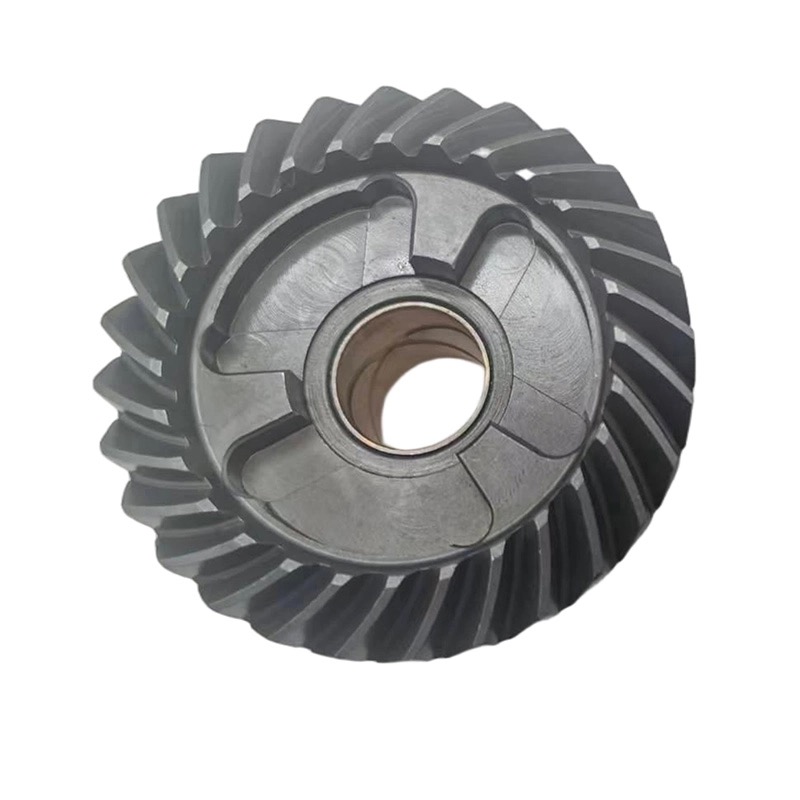
Outboard gears deserve stricter evaluation than a simple brand cross-reference.
A pinion, forward gear, or reverse gear operates within a coordinated assembly. Its relationship with the mating gears, shafts, bearings, and housing matters as much as its overall appearance.
From our manufacturing perspective, a useful distinction is between dimensional similarity and functional compatibility.
A gear may have a familiar bore diameter and tooth count while still differing in important features.
For a replacement-gear inquiry, the technical review should consider:
- Tooth count and mating-gear relationship.
- Tooth geometry and contact arrangement.
- Bore and spline specifications.
- Bearing-seat dimensions.
- Axial positioning.
- Clutch engagement features, where applicable.
- Material and heat-treatment requirements.
These are proposed evaluation criteria, not a claim that two specific Nissan and Mercury gears differ.
Without an identified application and drawing, no responsible manufacturer should promise interchangeability from photographs alone.
Backlash is the clearance between mating gear teeth. Shims are used in certain assemblies to establish the specified component positioning and clearance.
The Tohatsu MFS6D service manual provides model-specific backlash measurement and shim-adjustment procedures. That is useful evidence of why gear replacement involves setup—not just swapping components.
Its values must not be transferred to an unrelated Mercury or Nissan engine. Always use the instructions for the actual assembly being serviced.
When a gear is damaged, the repair review should also examine the surrounding assembly under the applicable service procedure.
Replacing only the visibly damaged component without evaluating related parts can leave the original problem unresolved.
For procurement teams, this means identifying whether the requirement is for a single gear, a coordinated replacement set, or a broader lower-unit repair.
The following examples are hypothetical purchasing situations, not reported customer cases.
A Mercury owner identifies an impeller through the correct serial-number catalog. A reputable cross-reference connects that number to the proposed Tohatsu/Nissan component.
This is a reasonable basis for further verification. The buyer should still confirm whether the offer is an impeller alone or a complete kit and check the applicable production range.
The key evidence is the documented part-number relationship.
A repairer finds a Nissan forward gear that resembles the removed Mercury gear.
The available evidence consists of photographs, approximate dimensions, and matching horsepower. No confirmed application or drawing is available.
The appropriate decision is to stop the purchase pending technical verification. Visual resemblance does not establish correct tooth contact, shaft fit, or assembly positioning.
A distributor locates a valid equivalent, but the original number has been superseded.
The next step is to verify the replacement chain and whether the new listing changes the supplied contents or installation requirements.
A superseded number can solve an availability problem, but it should be documented rather than assumed.
For professional buyers, compatibility should be recorded in a reusable application file.
A practical approval record includes:
| Record field | Purpose |
|---|---|
| Receiving engine model and serial range | Defines the actual application |
| Original Mercury number | Establishes the catalog starting point |
| Proposed Nissan/Tohatsu number | Identifies the alternative |
| Cross-reference source | Records the basis for interchange |
| Drawing or specification revision | Controls technical changes |
| Supplied contents | Distinguishes parts, kits, and assemblies |
| Installation requirements | Prevents overlooked setup work |
| Approval status | Separates confirmed from unverified applications |
This is a proposed purchasing framework rather than a manufacturer-issued compatibility standard.
Its value is consistency: the next buyer can see why an application was approved instead of relying on an undocumented conversation.
For bulk gear sourcing, request dimensional inspection requirements and relevant material or heat-treatment documentation as part of the quotation process.
Ningbo Gill Transmission Parts Co., LTD. specializes in the development, production, and sale of outboard gears and other marine components, supported by 29 years of professional experience.
To request a focused technical discussion, send our team:
1. Engine brand, complete model, and serial number.
2. Original component number and proposed replacement number.
3. Clear photographs of the component and its markings.
4. Available drawings and critical dimensions.
5. Required quantity and intended application.
For gear inquiries, include tooth counts, mating-component information, and relevant assembly details where available.
Contact Ningbo Gill Transmission Parts Co., LTD. with this information to discuss your replacement-gear or manufacturing requirements. Any compatibility proposal should remain subject to application-specific verification.
No. Some components have documented equivalents because certain Mercury models share Tohatsu manufacturing origins. Compatibility must be confirmed for the individual part and receiving engine.
Corresponding Nissan and Tohatsu applications commonly share components. Select the correct model and production range, and check catalog notes for brand-specific exceptions.
Only after verifying the exact application, component specifications, mating parts, and service requirements. Matching horsepower or appearance is insufficient.
No. MarineEngine's cross-reference explains that different brands may assign different numbers to the same component. A documented equivalent matters more than number similarity.
For Mercury parts lookup, the manufacturer recommends the serial number. It identifies the relevant application more precisely than a broad year or horsepower description.
No. Backlash measurement methods and limits are application-specific. Use the correct service manual for the engine and gearcase being repaired.
- Nissan Marine — [Nissan Outboards]. Manufacturer statement covering Tohatsu production, discontinued Nissan outboard sales, and support through Tohatsu. [nissanmarine]
- Tohatsu Marine Corporation — [Tohatsu Marine Story]. Primary-source explanation of the February 1988 joint venture with Brunswick and the Mercury manufacturing relationship. [tohatsumarine.co]
- Mercury Marine — [Mercury Marine Parts Digital Catalog]. Manufacturer guidance on engine identification, serial-number lookup, diagrams, and part numbers. [mercurymarine]
- MarineEngine — [Tohatsu Outboard Part to Mercury Cross Reference]. Specialist cross-reference documenting selected component equivalents and different brand numbering. [marineengine]
- East Marine — [Tohatsu/Nissan Parts Catalog]. Catalog-selection guidance covering model applicability, serial-number changes, and brand-specific exceptions. [tohatsu]
- Tohatsu — [MFS6D Service Manual, hosted by Tohatsudelar]. Model-specific technical basis for the discussion of backlash measurement and shim adjustment; not a universal interchange specification. [tohatsudelar]


