


close
Choose Your Site
Global
Social Media
Views: 222 Author: Gill Transmission Publish Time: 2026-05-22 Origin: Site


Designing outboard gears and other marine transmission components is not just about getting the tooth geometry right – it is about translating a complete gear set concept into clear, manufacturable part drawings that survive harsh marine conditions. In this guide, I will walk through how experienced marine gear designers prepare and execute drawings for shafts, housings, keys, and related parts around the gear, based on real‑world practice in outboard drive systems. [mraa]

- How to structure drawings for gear‑related parts in outboard gearboxes
- Critical dimensions and tolerances for marine shaft, hub, and housing interfaces
- Practical steps from concept to released drawing set
- Expert tips to avoid common design and manufacturing failures in marine environments
- Where outboard‑gear manufacturers can add value and how to select a reliable supplier
In an outboard motor, the gear set is only as reliable as the parts around it: shafts, bearings, keys, splines, seals, and housings. If any of these interfaces are poorly defined on the drawing, problems like gear noise, micro‑pitting, shaft failure, and oil leakage quickly appear in service. [boatmarketingpros]
From my experience working with marine transmission suppliers, three drawing‑related issues cause most field problems:
- Ambiguous fits between gear bores and shafts, leading to fretting or slippage.
- Incomplete tolerance chains in the gear housing, causing misalignment or backlash drift.
- Under‑specified surface finishes and heat treatment, especially on bearing and seal journals in saltwater applications.
A robust drawing process for gear‑related components prevents these failures before the first part is machined.
For clarity and search relevance, we will focus on:
- Outboard gears
- Marine gear design
- Gear‑related part drawings
- Marine transmission components
- Outboard gearbox shaft and housing design
These terms reflect how marine engineers and purchasers typically search when they evaluate outboard gear suppliers and design resources. [cmlabs]
In practical marine gear design, drawing work starts once the basic gear data is fixed: module, number of teeth, face width, material, and required torque capacity. Then we design the surrounding components so that the entire system can be manufactured, assembled, and serviced with predictable quality.
Before drawing any part, confirm:
- Gear type: spur, helical, or bevel gear used in the outboard gearbox
- Mounting style: interference fit, keyed hub, spline, or shrink fit
- Bearing arrangement: overhung or between‑bearing support
- Required alignment accuracy and permissible backlash variation
At this stage, you should already know the gearbox layout – such as vertical input shaft from the powerhead and horizontal propeller shaft in a typical outboard lower unit. [boatmarketingpros]
A common mistake in marine gear drawings is failing to define a consistent datum system across shafts, gears, and housings. An expert approach is:
- Select primary datums along the shaft centerline and key bearing seats.
- Use gear pitch diameters and bearing bores as functional datums.
- Plan tolerance chains from bearing seats through gears to propeller or output flange.
These decisions determine how concentricity, runout, and backlash are controlled in production.
The gear shaft (drive shaft or propeller shaft) is the backbone of the outboard gear system. Its drawing must precisely define all functional sections.
For outboard shafts, focus on:
- Bearing journals – diameter, tolerance, and surface roughness for rolling bearings.
- Seal journals – hardness and surface finish suitable for lip seals in saltwater.
- Gear seats – either a straight seat for press‑fit gears or spline profile for sliding gears.
- Keyways or splines – geometry, tolerances, and fillet radii to avoid fatigue cracks.
- Shoulders and chamfers – for positioning gears and bearings, plus assembly ease.
On the drawing, each of these sections should have:
- A functional label (e.g., "Gear seat for forward gear")
- Fit specification (e.g., H7/p6 for interference fit)
- Relevant geometric tolerances (runout, concentricity, perpendicularity)
Marine environments impose extra demands that must appear on the drawing:
- Corrosion protection: materials (e.g., stainless or alloy steel) and surface treatments should be specified, not left to supplier discretion. [cmlabs]
- Sacrificial areas: if galvanic corrosion is expected, specify areas where sacrificial anodes will be attached.
- Heat treatment: case depth and hardness for gear seat and spline sections to support torque while avoiding brittle fracture.
I have seen outboard shafts fail in less than one season when drawings forgot to differentiate between standard industrial duty and continuous high‑load, saltwater duty. A marine‑grade drawing explicitly calls out these requirements.
The interface between gear bore and shaft is critical for torque transmission and alignment.
On the gear drawing, clearly define:
- Nominal bore diameter and tolerance class
- Surface finish of the bore
- Chamfers and lead‑ins for press‑fit assembly
- Keyway or spline data if applicable
A good practice is to specify the fit pair (e.g., "Bore Ø25 H7 with shaft Ø25 p6") in a technical note that appears on both the gear and shaft drawings. This removes ambiguity for the machinist and inspector.
To minimize gear noise and uneven tooth loading in outboard gears, you should:
- Reference the bore as the primary datum.
- Apply total runout tolerance of the gear teeth relative to the bore.
- Specify perpendicularity of side faces to the bore for correct gear position.
These geometric control frames are often missing in older drawings, but they are essential for modern quality expectations in marine transmissions. [intelegencia]
The housing drawing integrates all gear‑related parts and defines the structure of the outboard gearcase or gearhead.
A complete housing drawing for an outboard gearbox typically includes:
- Bearing bores and shoulders for the gear shafts
- Locating faces between upper and lower housings
- Sealing interfaces for oil seals and O‑rings
- Oil passages and venting features
- Bosses and threaded holes for fasteners and brackets
From a UX and manufacturing perspective, make sure the drawing communicates:
- Which surfaces are functional datums for assembly.
- Required flatness and parallelism for mounting faces.
- Tight tolerances where shaft alignment is critical, and looser tolerances elsewhere to control cost.
In practice, backlash in outboard gear sets is influenced by:
- Center distance between mating gears
- Bearing preload and shaft deflection
- Thermal expansion over operating temperature
Your housing drawing should therefore:
- Define center‑distance‑controlling bores with appropriate tolerances.
- Include notes on how bearing preload is set (shims, spacers, or threaded adjusters).
- Indicate inspection points or gauges used to verify alignment.
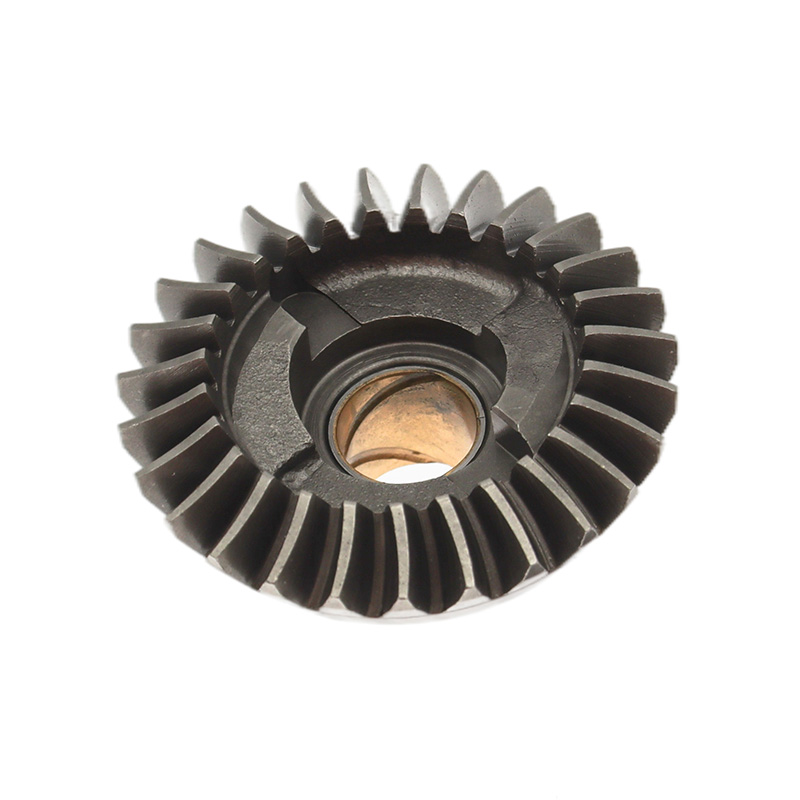
Below is a practical workflow that many experienced marine gear designers follow when executing gear‑related drawings.
- Confirm torque, speed, load spectrum, and duty cycle for the outboard application.
- Lock the gear macro data (module, tooth count, face width, contact ratio).
- Check space envelope within the existing or planned outboard housing.
- Choose mounting style for each gear: fixed or sliding, keyed or splined.
- Size shaft diameters based on bending and torsion, including shock loads in marine operation.
- Reserve length for bearings, seals, gears, and safety clearances.
- Add functional sections with step diameters and lengths.
- Specify fits, geometric tolerances, and surface finishes.
- Add heat treatment and material notes tailored for marine use.
- Arrange bearings and gears to achieve required center distances.
- Dimension all bearing bores and sealing surfaces with reference datums.
- Include machining and assembly notes to ensure practical manufacturability.
- Perform a tolerance stack‑up for backlash and shaft alignment.
- Simulate assembly order to ensure no interference or impossible steps.
- Update drawings with any required assembly aids (chamfers, access holes, lifting points).
- Pilot production will reveal if any drawing details are ambiguous or unrealistic.
- Encourage machinists and inspectors to mark up issues on printed drawings.
- Revise and control drawing versions to maintain traceability and E‑E‑A‑T‑compliant documentation. [digitalswot]
Drawing execution looks different in a company that both designs and manufactures outboard gears. As a manufacturer, you quickly learn which drawing decisions actually affect yield, consistency, and field reliability.
From collaboration with international outboard OEMs, typical drawing‑related pain points include:
- Over‑tight tolerances that drive up cost without improving function.
- Missing information on gear tooth finishing processes (e.g., grinding vs. shaving) and their impact on noise.
- Unclear material and heat‑treatment specifications, leading to inconsistent hardness in critical areas.
A manufacturer specializing in marine gears can help optimize these drawings by suggesting:
- More realistic tolerance levels tied to process capability.
- Standardized fits and surface finishes aligned with existing production tools.
- Consolidated notes and standards to reduce confusion for operators and inspectors. [boatmarketingpros]
When you involve your gear supplier early, the drawing phase becomes a joint exercise:
- You bring system‑level requirements and packaging constraints.
- The supplier brings manufacturing know‑how, tooling options, and marine‑specific failure data.
The result is a drawing set that is not only theoretically correct, but also highly manufacturable and robust for long‑term saltwater use.
One real‑world example shows how better gear‑related drawings can solve a long‑standing quality issue.
A boat OEM reported customer complaints about whine and vibration in the 2500–3500 rpm range. Gear geometry was already optimized, but tests showed inconsistent backlash and tooth contact patterns between units.
Drawing analysis and inspection revealed:
- Housing bearing bores had wide tolerance ranges and no geometric tolerance for coaxiality.
- Shaft runout was within the drawing limits, but these limits were too loose for the desired noise level.
- Gear bore surface finishes and chamfers varied by supplier, affecting mounting repeatability.
The engineering team and gear supplier updated the drawings to:
- Tighten bore tolerances and add total runout requirements.
- Standardize gear bore finishing and inspection methods.
- Clarify fit pairs on both shaft and gear drawings, including interference values.
Within two production cycles, measured backlash variation dropped significantly, and the OEM reported a marked reduction in customer noise complaints.
User experience is not just a website concern – it also applies to how engineers, machinists, and inspectors interact with drawings.
- Use clear section views for complex shaft and housing features.
- Group related dimensions by function (e.g., all gear seat dimensions together).
- Avoid clutter by moving repeated notes into a general note block or standard.
From a documentation UX perspective, each drawing should answer three questions at a glance:
1. What is this part's function in the outboard gear system?
2. Which surfaces are critical for functionality?
3. How will this part be inspected?
Modern manufacturing environments use CAD, CAM, and digital inspection systems. To support this: [uxtigers]
- Maintain consistency between 3D models and 2D drawings.
- Use model‑based definition (MBD) where appropriate.
- Provide standard naming and numbering conventions that connect drawings to BOM, ERP, and quality records.
This digital clarity indirectly supports your company's E‑E‑A‑T by demonstrating professional, traceable engineering practice. [intelegencia]
For many marine OEMs, the most effective way to improve gear‑related drawings is to partner with a specialized supplier that already produces outboard gears, shafts, and transmission parts at scale.
When evaluating a supplier, consider:
- Experience in outboard and marine applications, not only general industrial gears.
- Ability to provide complete gear, drive shaft, propeller shaft, and clutch dog solutions in one system. [gilltransmission]
- Proven machining capability for tight tolerances on bearing and gear seats.
- In‑house or certified heat treatment and surface treatment processes suitable for marine conditions.
- Willingness to support drawing optimization and co‑design efforts.
A partner with deep experience in marine transmission parts can often shorten your development cycle and reduce long‑term warranty risk.
If you are developing or updating an outboard gearbox or other marine transmission system, now is the right time to review your gear‑related drawings. Clarifying fits, tolerances, and marine‑specific requirements will improve reliability, reduce noise, and cut production scrap.
For OEMs looking for a partner who can support both design optimization and high‑quality production of outboard gears, shafts, and related components, consider collaborating with a dedicated marine transmission manufacturer that understands the full journey from drawing to sea‑trial performance. [gilltransmission]
Q1: What is the biggest mistake engineers make on gear‑related drawings for outboard motors?
The most common mistake is under‑specifying fits and geometric tolerances between gear bores, shafts, and housings, which leads to misalignment, noise, and premature wear in marine use. [cmlabs]
Q2: How tight should tolerances be for outboard gear shafts?
Tolerances should be based on functional requirements and process capability; typically, bearing and gear seats require tighter limits and geometric controls, while non‑critical sections can be looser to reduce cost. [intelegencia]
Q3: Why is corrosion protection called out on drawings rather than in a separate specification?
Including material, heat treatment, and surface‑treatment notes on the drawing makes them visible to machining, heat‑treat, and inspection teams, which is crucial to prevent corrosion‑related failures at sea. [cmlabs]
Q4: How do better drawings reduce gear noise in outboard gearboxes?
By controlling runout, concentricity, and center distances through clear tolerances and datums, you ensure consistent backlash and contact patterns, directly lowering gear whine and vibration. [intelegencia]
Q5: When should an OEM involve the gear supplier in the drawing process?
Ideally from the layout and preliminary drawing phase, so the supplier can advise on manufacturable tolerances, standard fits, and marine‑proven solutions, avoiding costly redesigns later. [gilltransmission]
1. "7 Simple SEO Tips for Marine Dealers," MRAA – content strategy insights for marine audiences. [https://mraa.com/7-simple-seo-tips-for-marine-dealers] [mraa]
2. "SEO Explained for Marine Businesses," Boat Marketing Pros – on‑site and off‑site SEO for marine companies. [https://boatmarketingpros.com/seo-explained-by-a-marine-marketing-agency/] [boatmarketingpros]
3. "E‑E‑A‑T and Content Strategy: Building Trust and Authority," Intelegencia – guidance on building authoritative technical content. [https://www.intelegencia.com/blog/content-marketing/eeat-and-content-strategy-for-building-trust-and-authority] [intelegencia]
4. "E‑E‑A‑T SEO: How to Improve It for Your Website," Digital SWOT – practical ways to demonstrate experience and expertise. [https://digitalswot.ae/blog/eeat-seo-how-to-improve/] [digitalswot]
5. "SEO for Marine Shipping Companies," cmlabs – best practices for marine and shipping‑related search optimization. [https://cmlabs.co/en-id/sector-industry/transportation-companies/marine-shipping] [cmlabs]
6. "Gear, Drive Shaft, Propeller Shaft, Clutch Dog Manufacturer," Gill Transmission – example of integrated marine transmission manufacturing. [https://www.gilltransmission.com] [gilltransmission]


