


close
Choose Your Site
Global
Social Media
Views: 222 Author: Gill Transmission Publish Time: 2026-05-15 Origin: Site


As a marine gear specialist with over two decades of manufacturing experience at Ningbo Gill Transmission Parts Co., LTD., I've witnessed firsthand how proper gear design procedures directly impact the reliability and performance of outboard motor systems. The global outboard motor market is projected to reach USD 12.48 billion by 2031, growing at a 4.99% CAGR, driven by stricter emission standards and demand for high-performance propulsion systems. This growth necessitates precision-engineered gear components that can withstand the unique challenges of marine environments while delivering optimal power transmission efficiency. [finance.yahoo]
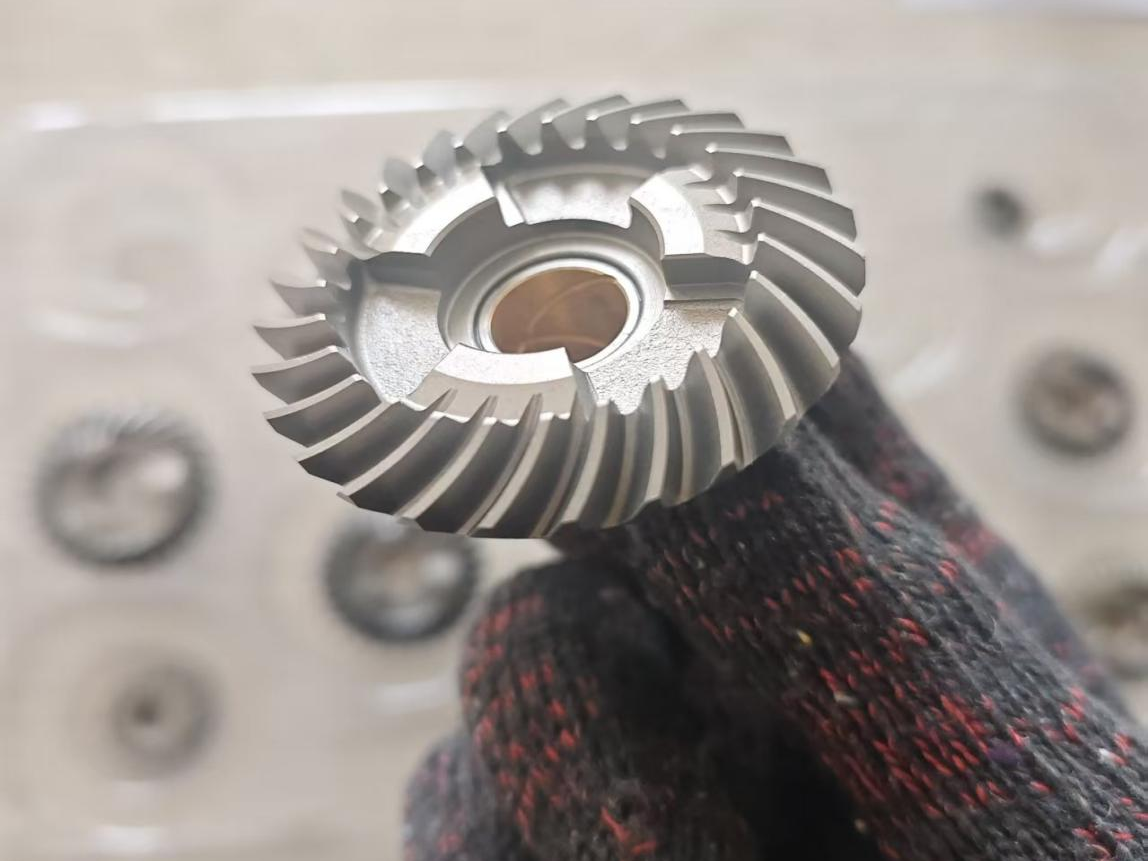
Gear design encompasses a systematic engineering process that balances mechanical strength, operational efficiency, and manufacturing feasibility. For marine outboard applications, designers must account for continuous load cycles, corrosion resistance, and the extreme torque demands of modern high-horsepower engines. The fundamental approach involves three critical evaluation criteria: bending strength (resistance to tooth breakage), wear resistance (surface durability under contact stress), and surface endurance (long-term pitting resistance). [ptsmake]
The law of gearing and involute geometry form the theoretical foundation, ensuring smooth power transmission through proper tooth contact ratios. In marine gearboxes, these principles become particularly important as manufacturers respond to the industry trend toward retrofitting triple or quad 300-plus-horsepower outboards, such as Mercury Marine's V10 Verado, which demand exceptional gear strength without increasing overall system weight. [globenewswire]
The design process begins with clearly defining operational parameters: required torque capacity, input/output speed ratios, power transmission requirements, and environmental conditions. For outboard gears, ANSI/AGMA 6032-B13 standards provide specific guidelines for marine propulsion reduction gears driven by internal combustion engines ranging from 1,500 to 20,000 horsepower per prime mover, with rotor speeds not exceeding 3,600 rpm. [khkgears]
Critical specifications include module or diametral pitch selection, pressure angle determination (typically 20° for marine applications), and material selection based on strength-to-weight ratios. Modern outboard manufacturers increasingly specify materials that balance corrosion resistance with mechanical properties, as aluminum boat production integration and supply chain stabilization become industry priorities. [gearkade]
Once specifications are established, engineers develop the gear tooth geometry including addendum, dedendum, tooth thickness, and root fillet radius. The involute tooth profile ensures constant velocity ratio and allows for manufacturing tolerances while maintaining proper meshing characteristics. [scribd]
For spur and helical gears common in marine reduction systems, designers calculate the pitch circle diameter, base circle diameter, and contact ratio to ensure minimum overlap of 1.2 for smooth operation. Helical gears offer advantages in marine applications due to quieter operation and higher load capacity, though they introduce axial thrust that must be accommodated in bearing design. [blog.ansi]
Bending strength analysis uses the Lewis bending equation and AGMA methodology to calculate tooth root stress under transmitted loads. The calculation incorporates multiple factors: transmitted tangential load (Ft), overload factor (K₀), velocity factor (Kv), size factor (Ks), mounting factor (Km), and geometry factor (J). [scribd]
The bending stress formula ensures that actual stress does not exceed allowable stress, accounting for material properties, life expectancy, temperature conditions, and reliability requirements. For marine gears, a minimum safety factor of 2.0 is typically required for bending strength to account for shock loading from wave impacts and sudden throttle changes. [scribd]
Wear strength evaluation addresses surface contact stress using Hertzian contact theory. The wear strength calculation considers pitch diameter, face width, load distribution ratio (Q'), and material surface fatigue limit. Marine gears must demonstrate adequate wear factors, as continuous operation in saltwater environments accelerates surface degradation compared to industrial applications. [irjet]
Material choice fundamentally impacts gear performance and longevity. For outboard marine gears, common materials include case-hardened alloy steels (AISI 4140, 4340), which provide a hard, wear-resistant surface layer while maintaining a tough, ductile core. The surface hardness typically ranges from 58-62 HRC after carburizing and hardening, while the core maintains 30-35 HRC for impact resistance. [gearkade]
Alternative materials gaining traction include stainless steel alloys for superior corrosion resistance in saltwater environments and bronze alloys for specific worm gear applications where self-lubricating properties are advantageous. Material selection must align with the calculated allowable stresses, with ultimate tensile strength (Sut) directly influencing permissible bending stress (σbP = Sut/3 for typical safety margins). [wartsila]
Gear manufacturing methods significantly influence final product quality and cost. Hobbing remains the most economical process for producing external spur and helical gears in volume production, offering excellent accuracy and surface finish. Gear shaping is preferred for internal gears and situations where gear cutting must stop short of a shoulder. [gearkade]
For precision marine applications, grinding serves as a finishing operation after heat treatment to achieve tight tolerances (AGMA Quality Class 10-12) and correct distortions from thermal processes. Some high-performance outboard gears undergo shot peening to induce compressive residual stresses in tooth root fillets, significantly improving fatigue life. [blog.ansi]
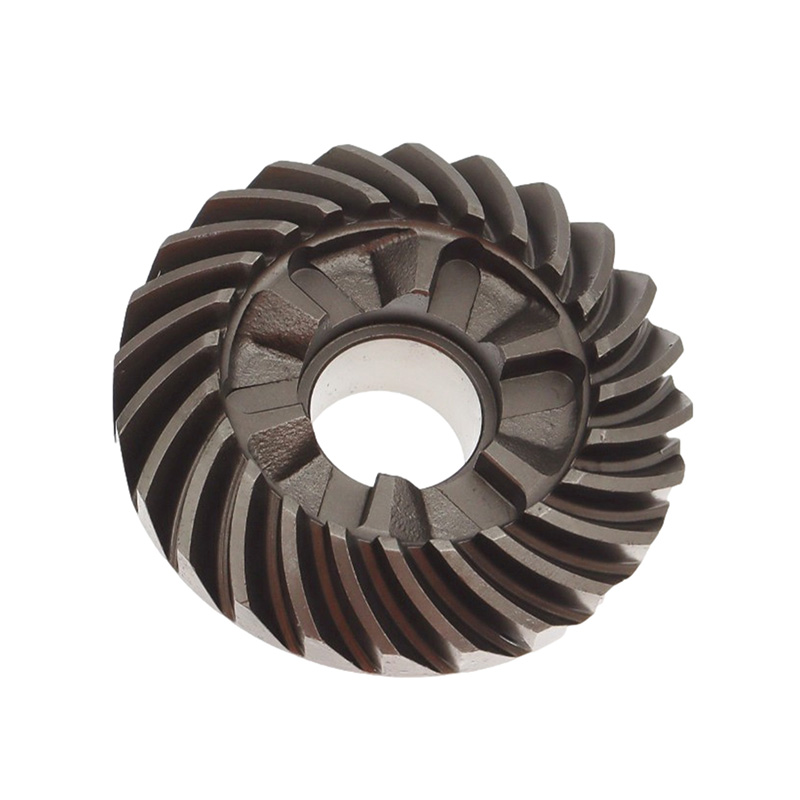
Saltwater exposure creates unique challenges for outboard gears. Beyond material selection, designers specify protective coatings such as electroless nickel plating, zinc-nickel alloys, or specialized marine-grade powder coatings. These coatings must maintain adhesion under cyclic loading while not significantly altering gear tooth dimensions or mesh characteristics. [blog.ansi]
Galvanic corrosion between dissimilar metals in the gear assembly requires careful consideration. Engineers use sacrificial anodes, isolation techniques, and compatible material pairings to minimize electrochemical degradation in seawater environments. [wartsila]
Marine gear units incorporate integral lubricating oil systems designed for the unique operating conditions of propulsion applications. The lubrication system must maintain adequate oil film thickness across varying speeds and loads while preventing water contamination. [wartsila]
Oil selection for marine gears typically involves SAE 30 or SAE 40 mineral oils with extreme pressure (EP) additives, though synthetic options offer improved performance in cold-water starting conditions. The system design includes filtration, cooling (often seawater heat exchangers), and pressure monitoring to ensure continuous protection of gear tooth surfaces. [blog.ansi]
Smooth operation at varying speeds requires attention to dynamic balance and tooth contact pattern optimization. Marine gearboxes often operate across wide RPM ranges as operators throttle between idle and full power, necessitating design features that minimize torsional vibration transmission to the propeller shaft. [blog.ansi]
Helical gear angles between 15-30° provide good balance between noise reduction and manageable thrust loads. Some premium outboard units employ double helical (herringbone) gears that eliminate axial thrust while providing exceptional smoothness and load capacity. [scribd]
The shift toward electric outboard motors, growing at 5.02% CAGR through 2031, is reshaping gear design requirements. Electric motors deliver full torque at zero RPM, creating different loading profiles than internal combustion engines. Gear designers must optimize for continuous high torque rather than the intermittent loading patterns of traditional engines. [finance.yahoo]
Direct-drive electric systems in some applications eliminate reduction gears entirely, while hybrid configurations require dual-input gearboxes that can seamlessly switch between or combine electric motor and conventional engine power. This complexity demands innovative clutch integration and control system coordination within the gear housing. [globenewswire]
Powder metallurgy and metal injection molding (MIM) are enabling complex gear geometries with reduced machining requirements. These processes offer particular advantages for smaller marine gears where production volumes justify tooling investment. [gearkade]
3D printing of prototype gears accelerates development cycles, allowing designers to validate tooth modifications and housing configurations before committing to production tooling. While production marine gears still primarily use traditional manufacturing, additive manufacturing informs design optimization through rapid iteration. [ptsmake]
Modern marine gearboxes increasingly incorporate sensor integration for real-time monitoring of temperature, vibration, and lubrication conditions. This data enables predictive maintenance strategies and provides valuable feedback to designers for continuous product improvement. [blog.ansi]
Digital twin technology allows manufacturers to simulate gear performance under various loading conditions, optimizing designs before physical prototypes. This approach reduces development time and improves first-time design success rates for new outboard gear applications. [ptsmake]
Comprehensive testing validates design calculations and manufacturing quality. Dimensional inspection using coordinate measuring machines (CMM) verifies critical parameters including pitch variation, profile deviation, and lead accuracy against AGMA quality standards. [blog.ansi]
Load testing subjects assembled gear units to rated torque and overspeed conditions, typically 150% of rated capacity for marine applications. Endurance testing cycles units through millions of load reversals to validate fatigue life predictions and identify potential failure modes before field deployment. [blog.ansi]
Non-destructive testing methods including magnetic particle inspection and ultrasonic examination detect subsurface defects in critical load-bearing components. For marine gears, corrosion resistance testing in saltwater spray chambers confirms coating performance and material suitability for harsh operating environments. [gearkade]
Consider designing a gear set for a mid-range recreational outboard motor (75-115 HP). The reduction typically operates at a 2:1 ratio, reducing engine speed from approximately 5,500 RPM to 2,750 RPM at the propeller shaft. [gilltransmission]
Design parameters might include: pinion with 15 teeth, gear with 30 teeth, module of 3.5mm, face width of 35mm, and 20° pressure angle. Material selection of AISI 4340 alloy steel provides ultimate tensile strength of 1,020 MPa (148 ksi) after heat treatment. [scribd]
Strength calculations using AGMA methods would verify bending safety factors exceeding 2.5 and contact stress safety factors above 1.8, ensuring reliable operation under typical recreational use patterns including occasional water skiing or tube towing. The helical gear angle of 20° balances smooth operation with manageable bearing loads from axial thrust components. [scribd]
At Ningbo Gill Transmission Parts Co., LTD., our expertise in high-precision outboard lower units reflects over 25,000 square meters of modern production facilities dedicated to marine gear manufacturing. The Asia-Pacific region's projected 5.13% CAGR in outboard motor growth through 2031 creates significant opportunities for specialized gear manufacturers who understand both the engineering fundamentals and practical application requirements. [globenewswire]
Commercial marine applications demand even more robust designs, with factor of safety requirements often increased to 3.0 or higher to account for continuous duty cycles and limited maintenance windows. Government investment in fleet modernization and sustainability initiatives is driving demand for fuel-efficient, low-emission propulsion systems that rely on optimized gear transmission efficiency. [globenewswire]
Whether you're developing next-generation electric outboard systems or optimizing traditional combustion-driven propulsion, proper gear design procedure forms the foundation of reliable marine transmission. Partner with experienced manufacturers who combine theoretical expertise with practical production capabilities to ensure your marine gear components meet the demanding requirements of today's outboard motor market.
Q1: What is the most critical factor in marine outboard gear design?
A1: The most critical factor is achieving adequate bending strength and wear resistance under continuous saltwater exposure and variable loading conditions. Marine gears must maintain a minimum safety factor of 2.0 for bending while incorporating corrosion-resistant materials and protective coatings to ensure long-term reliability in harsh environments.
Q2: How do gear design requirements differ between electric and combustion outboard motors?
A2: Electric outboard motors deliver full torque at zero RPM, creating constant high-torque loading profiles unlike the intermittent patterns of combustion engines. This requires gear designs optimized for continuous maximum stress rather than cyclical loading, often necessitating higher service factors and alternative heat treatment specifications to prevent premature surface fatigue.
Q3: What AGMA quality class is recommended for precision marine gearboxes?
A3: Precision marine reduction gears typically target AGMA Quality Class 10-12, achieved through grinding operations after heat treatment. This quality level ensures tight pitch tolerances, minimal profile deviation, and smooth operation across the wide RPM ranges typical of recreational and commercial marine applications, reducing vibration transmission to propeller shafts.
Q4: Why are helical gears preferred over spur gears in outboard applications?
A4: Helical gears offer multiple advantages for marine outboards: quieter operation due to gradual tooth engagement, higher load capacity through increased contact ratios, and smoother power transmission that reduces vibration. The typical 15-30° helix angle balances these benefits against manageable axial thrust loads that bearings must accommodate in the lower unit housing.
Q5: How does material selection impact marine gear corrosion resistance?
A5: Material selection directly determines corrosion performance in saltwater environments. Case-hardened alloy steels (AISI 4140, 4340) provide excellent strength but require protective coatings like electroless nickel plating. Stainless steel alloys offer superior inherent corrosion resistance but at higher material costs. Bronze alloys serve specialized applications requiring self-lubricating properties, with material choice balancing mechanical strength requirements against environmental durability needs.
1. KHK Gears. "Gear Design Procedure in Practical Design." https://khkgears.net/new/gear_knowledge/gear-design-procedure-in-practical-design/
2. PTS Make. "Practical Ultimate Guide to Custom Gear Design." September 11, 2025. https://www.ptsmake.com/practical-ultimate-guide-to-custom-gear-design/
3. ANSI Blog. "ANSI AGMA 6032 Standard for Marine Gear Units: Rating and Application for Spur and Helical Gear Teeth." May 15, 2025. https://blog.ansi.org/ansi/ansi-agma-6032-standard-for-marine-gear/
4. Globe Newswire. "Outboard Motors Global Market Report 2026-2031: Tightening Emission Standards Propel Shift to Four-Stroke and Electric Powertrains." January 21, 2026. https://finance.yahoo.com/news/outboard-motors-global-market-report-111200301.html
5. Gill Transmission. "Company News - Ningbo Gill Transmission Parts Co., Ltd." January 27, 2026. https://www.gilltransmission.com/Company-News-ic3194626.html
6. Scribd. "Handbook of Practical Gear Design | PDF." November 30, 2025. https://www.scribd.com/document/48684925/gears
7. Scribd. "AGMA Gear Bending Strength Design | PDF." May 22, 2025. https://www.scribd.com/doc/218158458/Gear-Strength
8. Scribd. "Bevel Gear | PDF | Gear | Mechanical Engineering." April 14, 2026. https://www.scribd.com/document/1001795481/Bevel-Gear
9. IRJET. "Bending and Wear Analysis of Spur Gear." https://www.irjet.net/archives/V4/i5/IRJET-V4I5549.pdf
10. Wärtsilä. "Marine Gears and Gearboxes." March 24, 2021. https://www.wartsila.com/marine/products/propulsors-and-gears/gears


