


close
Choose Your Site
Global
Social Media
Views: 222 Author: Gill Transmission Parts Publish Time: 2026-06-18 Origin: Site


Content Menu
● What Are Bevel Gears in Outboard Engines?
● Straight Bevel Gears – Design, Advantages, and Limitations
>> Straight Bevel Gear Geometry and Working Principle
>> Practical Advantages in Marine Gearboxes
>> Limitations You Need to Manage
● Spiral Bevel Gears – Structure, Performance, and Use Cases
>> Spiral Tooth Geometry and Load Distribution
>> Benefits in Modern High‑Performance Outboard Engines
>> Manufacturing Complexity and Cost Considerations
● Side‑by‑Side Comparison for Outboard Applications
● Industry Trends Shaping Outboard Gear Selection
>> Growing Demand for Precision, Quiet Powertrains
>> Asia‑Pacific as a Manufacturing and Marine Hub
● How an Experienced Marine Gear Supplier Adds Value
>> Translating Application Requirements into Gear Specifications
>> Process Control, Testing, and Traceability
● Practical Selection Framework – Spiral vs Straight Bevel Gears for Your Outboard
>> Step‑by‑Step Decision Checklist
>> Example Scenario – Re‑Engineering a 150–200 HP Outboard
● Why Partnering with a Specialist Outboard Gear Manufacturer Matters
>> Turning Real‑World Feedback into Better Gearsets
>> Supporting OEMs Across the Full Product Lifecycle
● Call to Action – Align Your Outboard Gearsets with Your Market Position
● FAQs About Spiral vs Straight Bevel Gears in Outboard Engines
Spiral bevel gears generally deliver smoother, quieter, higher‑load transmission in outboard engines, while straight bevel gears offer a simpler, more economical solution for lower‑speed, less noise‑sensitive applications. Choosing between them should be driven by your target horsepower range, duty cycle, and cost‑to‑performance priorities in real‑world marine conditions. [chamolgear]
Selecting the wrong bevel gear set for an outboard gearbox does not just create noise; it can shorten gear life, increase maintenance costs, and even risk sudden failure on the water. As a manufacturer with nearly three decades of experience in outboard gears and marine drivetrain components, Ningbo Gill Transmission Parts Co., LTD. has seen how a well‑matched gear design can transform overall engine feel, durability, and user satisfaction. [businessresearchinsights]
In this guide, we combine hands‑on manufacturing insight with current market and engineering data to help OEMs, aftermarket buyers, and marine engineers make a confident, technically sound choice between spiral bevel gears and straight bevel gears in outboard engines. You will find clear explanations, real‑world selection checklists, and practical tips drawn from thousands of actual gear sets delivered into the global marine market. [dataintelo]
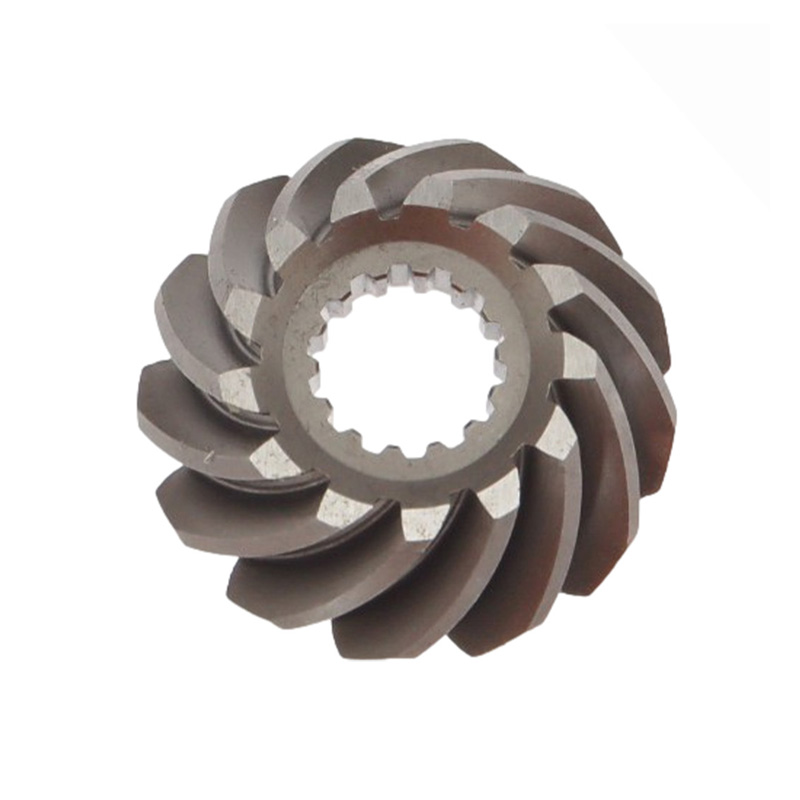
Bevel gears are conical gears used to transmit power between intersecting shafts, which in outboard engines means turning vertical crankshaft power horizontally to drive the propeller. Their geometry allows both a change in direction and efficient torque transfer inside a compact gearcase exposed to water, shock loads, and corrosion. [gearsolutions]
In a typical outboard lower unit, the vertical driveshaft engages a bevel gear set that redirects rotation 90 degrees to the propeller shaft. This assembly must balance three conflicting priorities: high torque capacity, resistance to pitting and wear, and stable, low‑noise operation across a wide RPM range. [chamolgear]
Straight bevel gears use tapered, straight teeth that converge toward the apex of the gear cone, with the mating pair meeting at the point where the two shafts intersect. Tooth engagement occurs along the entire face width almost simultaneously, which concentrates load and results in a more abrupt meshing action compared with spiral designs. [gearsolutions]
Because their geometry and tooling are relatively simple, straight bevel gears are easier to design, inspect, and manufacture, especially for moderate precision levels. This simplicity translates into shorter lead times and lower cost, which is attractive in less demanding marine applications or cost‑driven outboard platforms. [chamolgear]
From a user and purchasing perspective, straight bevel gears typically offer:
- Lower manufacturing cost and better price–performance ratio for low to medium horsepower outboards. [gearsolutions]
- Simpler production and maintenance, with fewer constraints on specialized cutting equipment and pairing. [gearsolutions]
- Robust performance at medium and low speeds, where extreme smoothness and noise control are not the primary design targets. [chamolgear]
For entry‑level fishing boats, work skiffs, or low‑speed utility craft where the engine rarely runs at prolonged wide‑open throttle, straight bevel gears can provide acceptable durability and drivability at an attractive cost. [chamolgear]
However, straight bevel gears do come with trade‑offs that become obvious in more demanding outboard use cases:
- Higher noise and vibration, due to sudden tooth contact and lower contact ratio. [gearsolutions]
- Lower load‑carrying capacity and shorter theoretical service life compared with spiral designs at similar sizes and materials. [chamolgear]
- Less forgiving under shock loads (for example, sudden throttle changes or hitting floating debris) because stress is less evenly distributed. [gearsolutions]
For OEMs targeting premium offshore, high‑speed, or heavy‑duty commercial segments, these drawbacks often justify upgrading to spiral bevel gear sets despite the higher initial gear cost. [chamolgear]
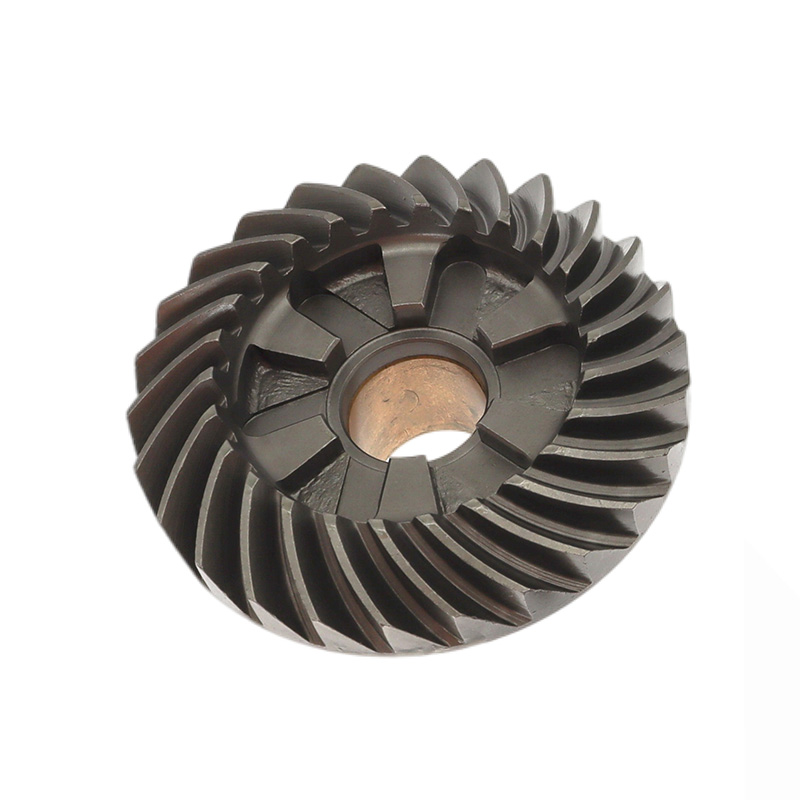
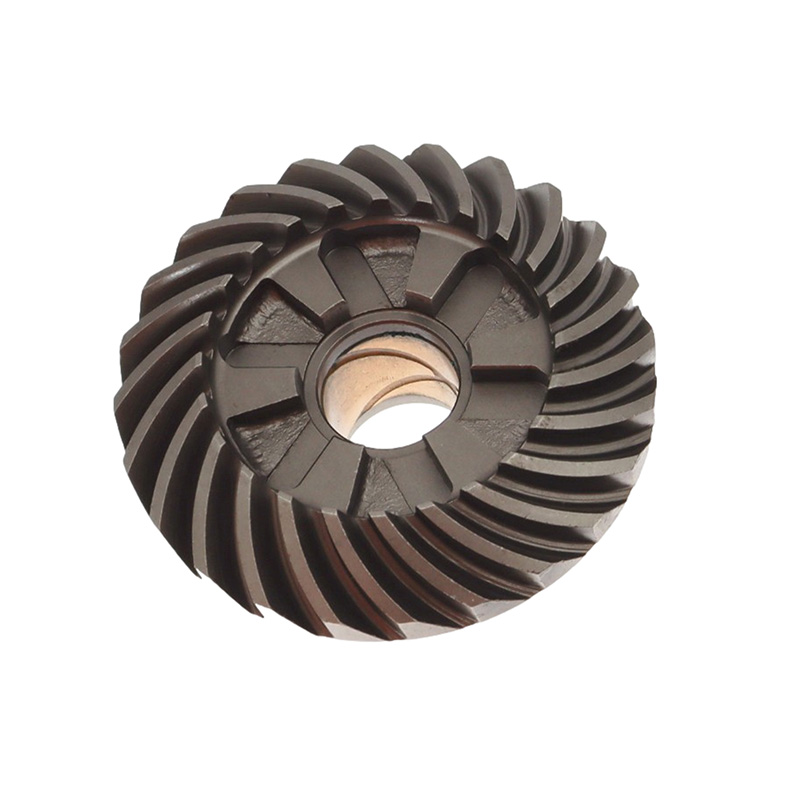
Spiral bevel gears use curved, angled teeth arranged in a spiral pattern on the conical surface, which dramatically changes how the gears engage under load. Instead of a single abrupt line of contact, the spiral form creates a progressive tooth engagement and a higher contact ratio along the tooth face. [gearsolutions]
This geometry distributes torque over a larger surface area, reducing peak stresses and improving resistance to pitting, scuffing, and tooth breakage. As a result, spiral bevel gears generally offer higher load‑carrying capacity, smoother operation, and lower noise levels, especially at elevated speeds and under variable loads. [chamolgear]
For today's higher‑horsepower, fuel‑efficient outboards, spiral bevel gears provide several practical advantages:
- Smoother and quieter running across the RPM range, improving perceived quality and comfort on board. [gearsolutions]
- Higher permissible torque and better overload behavior, which is critical for heavy boats, towing, and offshore conditions. [chamolgear]
- Improved fatigue life and reliability when properly designed, heat‑treated, and lubricated. [gearsolutions]
These advantages align with broader market trends toward higher precision power transmission, where the overall bevel gear market is forecast to grow steadily on the back of automotive, aerospace, and industrial demand for smoother, quieter, and more efficient gear systems. [businessresearchinsights]
The main price of this performance is complexity: spiral bevel gears require dedicated cutting and grinding equipment (such as Gleason or Klingelnberg systems), advanced process control, and careful pairing. Each gear set is typically designed and run as a matched pair, and replacement or re‑supply must respect those pairing tolerances for optimal service life. [cmgear]
This makes spiral bevel gears more expensive per unit than straight bevel gear sets and places higher demands on the supplier's process capability and quality system. For buyers, this means choosing a partner with proven spiral bevel expertise is more critical than simply focusing on unit price. [cmgear]
The table below summarizes key differences that matter most in typical outboard engine gearcases. [chamolgear]
| Design Aspect | Straight Bevel Gears | Spiral Bevel Gears |
|---|---|---|
| Tooth geometry | Straight, tapering toward apex (gearsolutions) | Curved, spiral on conical surface (chamolgear) |
| Load capacity | Moderate, suited to medium/low load (chamolgear) | High, handles heavy and fluctuating loads (chamolgear) |
| Noise and vibration | Higher noise, more vibration at speed (gearsolutions) | Very smooth and quiet running (chamolgear) |
| Speed suitability | Best for medium and low speeds (chamolgear) | Designed for high‑speed operation (chamolgear) |
| Manufacturing complexity | Simpler design and tooling (gearsolutions) | Requires specialized cutting and pairing (chamolgear) |
| Typical cost level | Lower initial gear cost (chamolgear) | Higher but justified by performance (chamolgear) |
| Typical uses | General machinery, low‑speed drives (chamolgear) | Robotics, automotive differentials, high‑performance drives and premium marine powertrains (chamolgear) |
For outboard engines that must balance quiet cruising, high‑speed runs, and long‑term durability, spiral bevel gears are usually the preferred choice, especially in mid‑to‑high horsepower segments. Where budget and simplicity dominate the specification, straight bevel designs still have a clear place. [gearsolutions]
Across multiple sectors, bevel gears are benefiting from a shift toward higher precision and lower noise transmission systems, with the global bevel gear market projected to expand steadily through the next decade. Outboard engines are part of this trend, as end users increasingly expect automotive‑like refinement even on small recreational craft. [dataintelo]
This pushes OEMs toward higher quality tooth forms, tighter tolerances, and better surface finishes, particularly in spiral bevel designs. In practice, that means more attention to heat treatment, grinding, and inspection, not just basic tooth cutting. [chamolgear]
Asia‑Pacific, and China in particular, continues to strengthen its position as a major manufacturing base for precision gears, including marine and power transmission components. This regional capacity expansion allows specialized suppliers to combine high‑volume production with increasingly sophisticated gear design and process control. [dggear]
For international outboard engine brands, this means it is now possible to source high‑precision spiral and straight bevel gears at competitive cost from experienced suppliers in this region, without sacrificing consistency or traceability. The key is choosing partners with a proven record in marine‑specific gear design rather than general‑purpose industrial products. [dggear]
Selecting the right bevel gear is not just a matter of choosing "spiral" or "straight"; it requires translating real‑world operating conditions into specific technical criteria. Important parameters include: [lsrpf]
- Engine horsepower and maximum RPM
- Boat type, loading pattern, and duty cycle
- Target noise and vibration levels for the vessel category
- Expected lubrication quality, contamination risk, and maintenance intervals
Experienced marine gear manufacturers can help you map these inputs into practical specifications such as module, pressure angle, accuracy class, material, and heat treatment, ensuring that the gear set is optimized for your actual outboard use case, not just generic machinery duty. [lsrpf]
High‑end bevel gear suppliers typically combine CNC cutting, precision heat treatment, and gear grinding with 100% inspection of critical dimensions to ensure consistent meshing quality. For marine gears, this may also include surface durability testing, salt‑spray‑resistant coatings, and batch‑level traceability for every set shipped. [dggear]
By controlling the entire chain from material selection through finished gear pairing and packaging, a specialist supplier can provide repeatable performance across large production runs, which is essential for global outboard engine platforms using common lower‑unit designs. [dggear]
Use this simple framework when specifying bevel gears for an outboard engine program:
1. Define your priority:
- If cost and simplicity dominate and noise is secondary, straight bevel gears may be sufficient. [gearsolutions]
- If performance, smoothness, and durability are key selling points, prioritize spiral bevel gears. [chamolgear]
2. Map operating conditions:
- High RPM, frequent full‑throttle, and heavy loads favor spiral bevel designs. [gearsolutions]
- Moderate speeds and lighter, intermittent loads can work well with straight bevel gears. [chamolgear]
3. Set noise and comfort targets:
- For premium brands and passenger‑sensitive applications (tourism, leisure), define strict noise limits and treat them as non‑negotiable, which typically points to spiral bevel gears. [gearsolutions]
4. Review lifecycle cost:
- Factor in warranty risk, downtime, and customer satisfaction; in many cases, the slightly higher gear cost is offset by fewer failures and higher perceived quality when using spiral bevel designs. [chamolgear]
5. Align with supplier capabilities:
- Confirm that your gear partner can design, pair, and inspect spiral bevel sets to marine standards, including corrosion resistance and gearcase integration. [lsrpf]
Consider a 150–200 HP outboard model being upgraded for quieter cruising and extended warranty coverage. User feedback highlights gear whine at mid‑range RPM and occasional lower‑unit failures under heavy load. In this case:
- Moving from a straight bevel gear set to a spiral bevel design with optimized tooth contact, higher precision, and improved surface treatment can significantly reduce noise and extend gear life. [gearsolutions]
- Working with a specialized marine gear manufacturer allows you to maintain gearcase envelope dimensions while upgrading tooth geometry, materials, and heat‑treatment strategy based on validated field data. [lsrpf]
This kind of targeted redesign often becomes a key marketing point for the updated engine generation, translating technical improvements directly into visible user benefits.
Marine applications are unforgiving: gearsets must deal with shock loads from waves, sudden throttle changes, and variable lubrication conditions that are rare in controlled industrial environments. Specialist suppliers that focus on outboard gears accumulate field data and customer feedback that directly inform improvements in gear geometry, finishing, and material choice. [gearsolutions]
By iterating designs over many product cycles, an experienced manufacturer can develop application‑specific tooth profiles and tolerances that outperform generic industrial bevel gears in marine environments. This capability is particularly valuable when you need to balance cost constraints with premium‑level reliability and comfort. [dggear]
A long‑term marine gear partner does more than cut teeth; they support you from early concept and prototyping through mass production and service‑parts planning. This includes: [lsrpf]
- Assisting with gearcase layout and shaft alignment checks
- Recommending materials, coatings, and heat treatment for saltwater use
- Providing matched gear sets and long‑term replacement support
- Helping investigate and resolve any field issues related to noise, wear, or failures
For global OEMs and distributors, this end‑to‑end support helps protect brand reputation and ensures that the gearset remains a strength—not a risk—in the overall outboard engine package. [dggear]
Whether you are designing a new outboard platform or upgrading an existing model, your choice between spiral and straight bevel gears will strongly influence noise, durability, and customer satisfaction over the entire product lifecycle. If you aim to compete in higher‑value segments—quiet family boats, offshore fishing, commercial passenger transport—a well‑engineered spiral bevel gear set is often the fastest way to elevate perceived quality and reduce field issues. [chamolgear]
Work closely with an experienced marine gear manufacturer to review your current gearbox performance, define clear targets, and translate them into an optimal bevel gear specification for your next‑generation outboard engines. [dggear]
Q1: Are spiral bevel gears always the better choice for outboard engines?
A1: Not always. Spiral bevel gears are superior for high‑speed, high‑load, low‑noise applications, but well‑designed straight bevel gears can still be the most economical choice for lower‑power or less noise‑sensitive outboards. [chamolgear]
Q2: Why do spiral bevel gears cost more than straight bevel gears?
A2: Spiral bevel gears require specialized cutting and grinding machines, more complex tooling, and precise matched‑pair production, which all increase unit cost compared with simpler straight bevel designs. [cmgear]
Q3: Will switching from straight to spiral bevel gears reduce gear noise in an existing outboard model?
A3: In many cases, yes—spiral bevel gears offer smoother engagement and higher contact ratios, which significantly reduce whine and vibration, especially at mid‑to‑high RPM. However, overall noise also depends on housing design, lubrication, and shaft alignment. [chamolgear]
Q4: How does bevel gear choice affect outboard gearbox lifespan?
A4: Spiral bevel gears typically provide longer fatigue life and better resistance to pitting and scuffing under heavy loads, assuming proper design and lubrication, whereas straight bevel gears may reach their limits sooner in demanding conditions. [gearsolutions]
Q5: What should I look for in a bevel gear supplier for outboard applications?
A5: Prioritize marine‑specific experience, process control, and inspection capability—including spiral bevel machining expertise, material and heat‑treatment know‑how, and proven support for global OEM programs. [lsrpf]
1. Business Research Insights. "Bevel Gears Market Size, Share, Growth, Trends, 2032."
https://www.businessresearchinsights.com/market-reports/bevel-gears-market-115543 [businessresearchinsights]
2. Dataintelo. "Bevel Gears Market Research Report 2034."
https://dataintelo.com/report/global-bevel-gears-market [dataintelo]
3. Chamol Gear. "Spiral Bevel Gear vs Straight Bevel Gear."
https://www.chamolgear.com/spiral-bevel-gear-vs-straight-bevel-gear/ [chamolgear]
4. Gear Solutions Magazine. "Straight-tooth vs. spiral-tooth bevel gearing."
https://gearsolutions.com/departments/tooth-tips/straight-tooth-vs-spiral-tooth-bevel-gearing/ [gearsolutions]
5. CM Gear. "Helical vs Bevel Gears: Ultimate Performance Comparison Guide."
https://www.cmgear.us/feeds/blog/helical-vs-bevel-gears-performance-comparison [cmgear]
6. Ningbo Yinzhou Donggang Gear Manufacturing Factory – Company Profile.
https://www.dggear.com/html/en/ [dggear]
7. LS Precision. "The Ultimate Guide to Types of Gears: Spur, Helical, Bevel, Worm and More."
https://www.lsrpf.com/zh-Hans/blog/the-ultimate-guide-to-types-of-gears-spur-helical-bevel-worm-and-more [lsrpf]


