
Views: 288 Author: Gill Transmission Parts Publish Time: 2026-10-29 Origin: Site


Content Menu
● Are Suzuki Outboard Parts Compatible with Yamaha Parts?
● Suzuki vs Yamaha Parts: Why Similar Engines Need Different Components
>> Horsepower Does Not Define Mechanical Fit
>> Model Identity Matters More Than Appearance
>> A Catalog Diagram Is Not a Dimensional Drawing
● Suzuki vs Yamaha Outboard Gears Compatibility
>> Compare the Gear Mesh, Not Just the Tooth Count
>> Do Not Treat a Replacement Gear as an Isolated Item
● Suzuki vs Yamaha Crankshafts: Why Engine Architecture Controls Fit
>> Manufacturing Quality Cannot Be Judged from a Photograph
● Suzuki vs Yamaha Drive Shafts: Length Is Only the Starting Point
>> Check Both Ends and Every Functional Surface
>> Do Not Modify a Near-Match into an Assumed Replacement
● Suzuki vs Yamaha Propeller Shafts: Separate External Fit from Internal Compatibility
>> What a Propeller Shaft Comparison Must Include
>> Interchangeable Propeller Hubs Are a Different Product Category
● A Six-Step Suzuki and Yamaha Parts Compatibility Check
>> 1. Record the Engine Identification
>> 2. Find the Correct Catalog Entry
>> 3. Confirm Any Replacement Part Number
>> 4. Compare Functional Interfaces
>> 5. Verify Manufacturing and Supply Evidence
>> 6. Validate the Installed Assembly
● Expert Procurement Insight: Separate Fit, Function, and Durability
● Illustrative Workshop Scenario: The Same-Horsepower Trap
● Genuine vs Aftermarket Parts: Compare Evidence, Not Labels
● Request a Model-Specific Marine Parts Review
>> Can Suzuki outboard parts fit Yamaha engines?
>> Are Suzuki and Yamaha outboard gears interchangeable?
>> Will the same spline count make two propeller shafts compatible?
>> Can one aftermarket propeller work on Suzuki and Yamaha outboards?
>> What information should I provide when ordering marine transmission parts?
>> Should I choose genuine or aftermarket replacement parts?
Suzuki outboard parts vs Yamaha parts compatibility comes down to one principle: similar appearance does not establish interchangeability. Outboard gears, crankshafts, drive shafts, and propeller shafts must match the specific engine and assembly—not simply its horsepower.
For boat owners, repair workshops, and marine distributors, the practical question is not which brand makes better parts. It is whether a particular replacement meets the original component's dimensional, mechanical, and operating requirements.
At Ningbo Gill Transmission Parts Co., LTD., our focus is the development, production, and sale of marine transmission components, supported by 29 years of professional experience. From a manufacturing perspective, we recommend treating compatibility as a documented engineering decision rather than a visual comparison.
This guide explains what buyers should compare, where confusion arises, and how to evaluate replacement parts before ordering.

There is no blanket interchangeability between Suzuki and Yamaha outboard parts. Treat internal engine and transmission components as application-specific unless reliable documentation confirms the exact alternative.
Suzuki describes its genuine parts as engineered specifically for Suzuki outboards. Yamaha's parts finder allows searches by model or serial number and advises buyers to reconfirm model, model year, and part numbers before ordering.
The most important purchasing keyword is verification.
Even within one brand, shared horsepower does not establish that two engines use the same component. Differences in production generation, shaft length, gearcase configuration, or rotation can change the required replacement.
| Component | Cross-brand purchasing position | What must be verified |
|---|---|---|
| Outboard gears | Do not assume interchangeability | Tooth geometry, mating components, ratio, mounting dimensions |
| Crankshafts | Treat as engine-specific | Journal dimensions, stroke, bearings, timing interfaces |
| Drive shafts | Treat as assembly-specific | Length, splines, bearing locations, pinion connection |
| Propeller shafts | Treat as gearcase-specific | Internal interfaces, bearing seats, seal surfaces, rotation |
| Propellers with interchangeable hubs | Potentially adaptable within a listed system | Exact propeller, hub kit, engine application, hardware |
| Bearings and seals | Consider only after specification checks | Dimensions, material, construction, operating suitability |
This table is a screening guide, not a cross-reference catalog.
Horsepower describes engine output. It does not specify crankshaft journal diameter, shaft spline geometry, bearing arrangement, or gear tooth design.
For example, two equally rated outboards may use different powerhead designs and transmission arrangements. A replacement advertised only as "suitable for 115 HP outboards" therefore provides insufficient information for a critical internal component.
Start with engine identity, then establish the part number.
A useful identification record includes:
- Manufacturer and complete model designation.
- Engine serial number.
- Model year, where applicable.
- Shaft-length configuration.
- Standard or counter-rotation configuration.
- Existing part number and any documented replacement number.
Also record the sales market. Yamaha explicitly states that its U.S. parts catalog covers models sold in the United States. International buyers should avoid assuming that a catalog from another market resolves every application question.
Exploded diagrams help identify components and assembly relationships. They do not provide all the information needed to approve a cross-brand substitution.
Two gears can look nearly identical in separate diagrams while differing in tooth geometry or mounting details. Use diagrams for identification—not as proof of engineering equivalence.
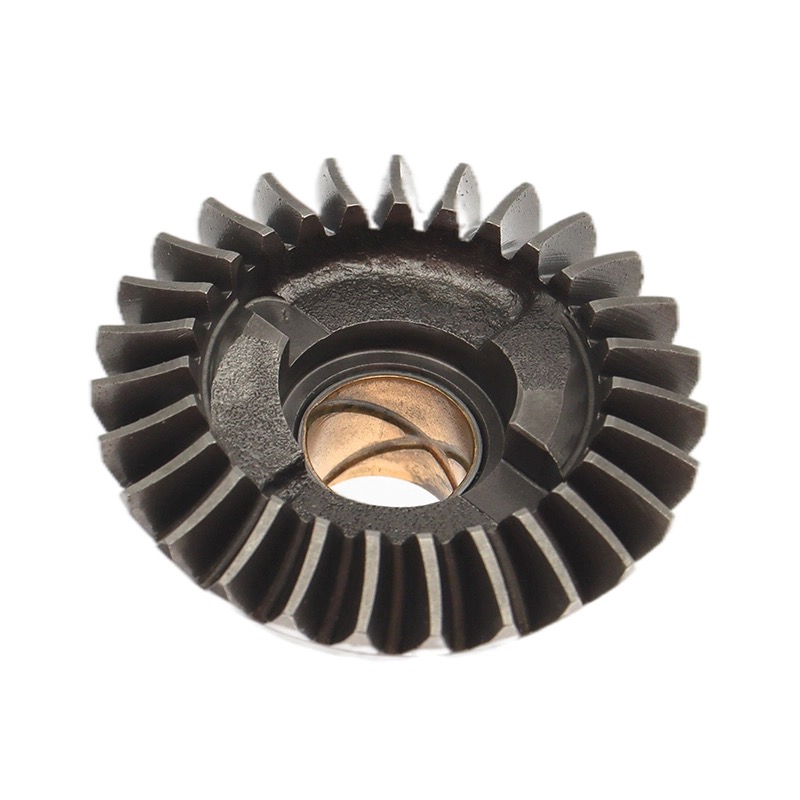
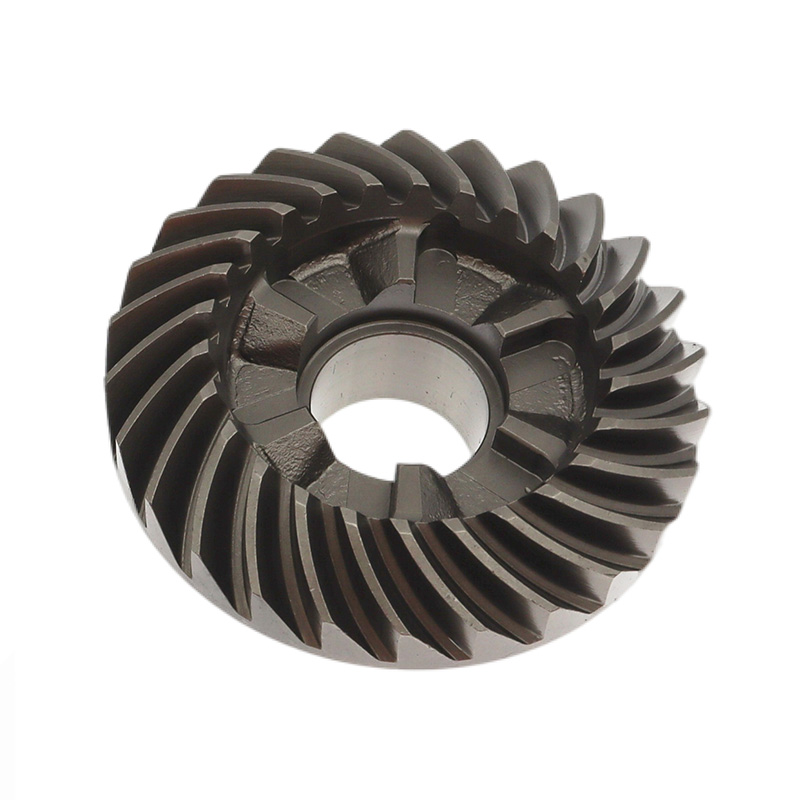
Outboard gears operate as part of a coordinated transmission system. Compatibility depends on how the replacement interacts with the mating gears, bearings, housing, and shifting components.
Important checks include:
- Tooth count and intended gear ratio.
- Tooth geometry and spiral direction, where applicable.
- Bore, spline, and mounting dimensions.
- Bearing and thrust interfaces.
- Clutch engagement features.
- Specified assembly clearances.
Matching tooth count alone is insufficient. It does not establish that two tooth surfaces will mesh correctly.
Backlash—the clearance between mating tooth flanks—also matters. Gear engineering guidance explains that eliminating necessary backlash can interfere with lubrication and create excessive tooth engagement.
Before replacing a damaged gear, inspect the related components. A worn bearing, damaged housing, or deteriorated mating gear can compromise a new part.
Our recommended purchasing question is: "What must be checked or replaced alongside this gear?"
Require the applicable service procedure to determine whether individual replacement is permitted and how backlash, tooth contact, and other assembly settings must be verified. Do not substitute generic clearance values for engine-specific instructions.
A crankshaft connects combustion forces to the rotating drivetrain. Its suitability depends on much more than overall length or cylinder count.
A meaningful crankshaft comparison examines:
| Inspection area | Compatibility question |
|---|---|
| Main journals | Do diameter, width, and bearing requirements match? |
| Crankpins | Are dimensions and connecting-rod interfaces correct? |
| Stroke | Does the crank geometry match the engine design? |
| End connections | Do flywheel and drive interfaces match? |
| Timing features | Are drive and reference features correctly positioned? |
| Lubrication features | Do required oil passages and interfaces correspond? |
| Alignment | Does measured runout meet the applicable specification? |
A clean finish does not establish suitable material, heat treatment, dimensional accuracy, or internal integrity.
For aftermarket crankshafts, request application identification and relevant inspection evidence. Depending on the component specification, that may include journal measurements, runout results, material documentation, and appropriate defect inspection.
Do not assume that "forged," "precision-machined," or "heavy-duty" automatically proves suitability. These descriptions need supporting specifications.
Without an established application reference, a Suzuki crankshaft should not be presented as a direct Yamaha replacement—or vice versa.
A drive shaft transfers rotation through the outboard's vertical drivetrain. Correct overall length is necessary, but it does not establish complete compatibility.
Compare:
- Upper and lower spline geometry.
- Spline engagement length.
- Pinion attachment arrangement.
- Bearing and shoulder locations.
- Water-pump drive features.
- Seal-running surfaces.
- Straightness and specified runout.
Counting splines is useful, but two shafts with the same spline count can still differ in diameter, tooth form, or engagement length.
Shortening a shaft, altering splines, or changing a bearing seat creates an engineering modification—not a catalog substitution.
Such work requires a controlled design assessment, appropriate manufacturing processes, and validation. For normal repair procurement, the safer route is an identified replacement matching the required assembly.
When evaluating Suzuki outboard drive shafts or Yamaha drive shaft replacements, provide the full engine identification and shaft configuration before requesting a quotation.
Propeller shafts create a common misunderstanding because buyers often focus on the visible spline that carries the propeller.
However, the internal portion must also work with the gearcase assembly.
Check the external propeller connection alongside:
- Internal gear and clutch interfaces.
- Bearing journals and thrust surfaces.
- Seal-running diameters and locations.
- Retaining features.
- Overall geometry and runout.
- Applicable rotation configuration.
A propeller that fits the exposed spline does not prove that the complete shaft fits another manufacturer's lower unit.
Some aftermarket propeller systems use interchangeable hubs. This can allow a compatible propeller housing to serve multiple listed engine applications with the appropriate hub and hardware.
That does not make Suzuki and Yamaha propeller shafts interchangeable.
For example, published Rubex listings identify a Suzuki RBX-110 application with a 13-tooth spline and a Yamaha RBX-203 application with a 15-spline configuration. These are application examples, not universal specifications for either brand.
Always check the current application listing for the exact engine and propeller combination.
Photograph the identification plate and write down the full model and serial number. Record shaft length and rotation configuration where relevant.
Avoid relying solely on the boat's registration year or an owner's recollection.
Locate the component in the appropriate manufacturer's parts catalog. Record its part number, assembly position, and any applicability notes.
Check whether the component belongs to the powerhead, drive shaft housing, or lower unit.
If a supplier proposes a superseding number, ask for documentation linking it to the original application.
A seller's "replacement for" description is not the same as a manufacturer-confirmed supersession.
For critical gears and shafts, request a drawing or inspection record covering the relevant dimensions and interfaces.
Measurements should reference an accepted specification. Measuring a worn component alone may reproduce wear rather than the intended design.
Ask for relevant material, heat-treatment, dimensional, and traceability documentation.
The evidence should correspond to the supplied component or production batch—not merely to a generic product brochure.
Have a qualified technician follow the applicable service procedure, including required alignment, clearances, sealing checks, and operational testing.
Successful assembly is not, by itself, proof of correct loaded operation.
A useful supplier-evaluation method separates compatibility into three questions.
| Evaluation layer | Question | Useful evidence |
|---|---|---|
| Fit | Will it assemble correctly? | Application reference, dimensions, interface inspection |
| Function | Will the assembly operate as intended? | Correct configuration and prescribed assembly checks |
| Durability | Can it withstand the intended service? | Relevant material, processing, and validation records |
This framework prevents a common purchasing mistake: accepting physical fit as proof of service suitability.
For a distributor, it also improves product descriptions. A listing should identify supported applications and limitations instead of promising broad "Suzuki/Yamaha compatibility."
Consider a workshop sourcing a propeller shaft for a Suzuki outboard. A supplier offers a visually similar Yamaha application shaft at a lower price.
This is an illustrative scenario, not a documented customer case.
Before comparing prices, the workshop should request the original part reference, internal-interface dimensions, bearing-seat locations, and seal-surface details.
If those details cannot be established, the alternative remains unverified.
The commercial lesson is straightforward: compare the cost of a confirmed replacement with another confirmed replacement. An undocumented near-match is not an equivalent purchasing option.
Genuine components provide a manufacturer-defined application route. However, buyers must still order the correct item for the engine.
Aftermarket components require equally clear application identification. Evaluate them using:
- Specific model and part-number coverage.
- Relevant dimensional inspection.
- Material and processing requirements.
- Batch identification and traceability.
- Clear warranty and claim procedures.
- Technical support for fitment questions.
Neither price nor country of origin establishes compatibility. Likewise, no evidence presented here supports a blanket claim that Suzuki parts are more durable than Yamaha parts, or the reverse.
For Ningbo Gill Transmission Parts Co., LTD., the right starting point is a defined application—not a broad promise of cross-brand interchangeability.
Send your engine model, serial number, original part number, photographs, required quantity, and available drawings when enquiring about outboard gears, crankshafts, drive shafts, or propeller shafts.
Ask for a model-specific review and a quotation that identifies the proposed component, relevant specifications, and supporting documentation. If the application remains uncertain, resolve that uncertainty before ordering.
Some separately specified accessories or aftermarket systems may cover applications from both brands. Critical internal components should not be treated as interchangeable without documented, application-specific confirmation.
Do not assume so. Tooth count, appearance, or horsepower cannot establish compatibility. Gear geometry, mounting interfaces, mating components, and assembly requirements must be verified.
No. Spline diameter, tooth form, engagement length, internal interfaces, bearing seats, and seal surfaces also matter.
Potentially, within a propeller system explicitly listing both applications and using the correct hub kits and hardware. Confirm the exact engine coverage; propeller adaptability does not establish shaft interchangeability.
Provide the manufacturer, full model, serial number, original part number, shaft configuration, rotation where applicable, and clear photographs. Drawings and inspection requirements help with technical sourcing.
Choose an accurately identified component with evidence appropriate to its role. Genuine parts offer manufacturer-defined applications; aftermarket alternatives need clear fitment information and credible quality documentation.
1. [Suzuki Marine USA — Genuine Parts & Accessories]. Manufacturer guidance on application-specific parts, reliability, performance, and engine life. [suzukimarine]
2. [Yamaha Motor Corporation, U.S.A. — Outboard Parts Finder]. Model and serial-number lookup, U.S.-market catalog scope, and part-number reconfirmation guidance. [yamaha-motor]
3. [Suzuki Marine — Suzuki Genuine Parts]. Manufacturer statements on product-specific design, specifications, and testing criteria. [store.suzukimarine]
4. [Yamaha Outboards — Propellers FAQs]. Explanation of propeller markings and application-related series identification. [yamahaoutboards]
5. [KHK USA — A Primer on Backlash and Its Purpose in Gear Designs]. General engineering guidance on backlash, lubrication, and excessive tooth engagement; not an outboard service specification. [khkgears]
6. [Overton's — Solas Rubex RBX-110 Hub Kit]. Retail application listing identifying selected Suzuki applications and spline configuration. Confirm current coverage before purchase. [overtons]
7. [Getaprop — RBX203 Solas Rubex Hub Kit, Yamaha 75–130 HP]. Retail application listing identifying selected Yamaha applications and spline configuration. Confirm current coverage before purchase. [getaprop]


