


close
Choose Your Site
Global
Social Media
Views: 222 Author: Gill Transmission Publish Time: 2026-04-27 Origin: Site


When you design or select outboard gears for modern marine engines, understanding gear forces is not an academic exercise – it directly impacts reliability, noise, efficiency and total cost of ownership on the water. As a manufacturer focused on outboard gears and marine transmission parts, we have seen the difference that correct force analysis makes in real-world applications, from small fishing boats to high-output offshore engines. [machineryoffers]
In this guide, I will walk through the tangential, radial and axial forces in gears, explain how they translate into bending and contact stresses, and connect these concepts to the specific realities of outboard lower units and marine drivetrains. The article is written for design engineers, technical buyers and marine OEMs who need both theory and practical engineering judgment in one place. [scubemarketing]
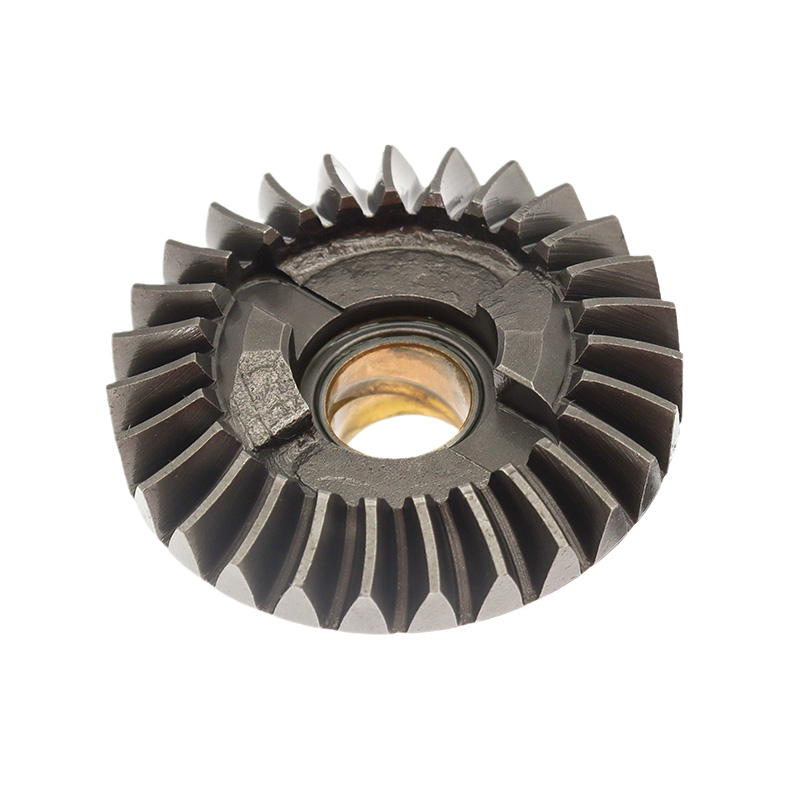
In any marine gearbox, gear forces define how loads move from the engine crankshaft down to the propeller – and where failures will occur if the design is weak. In outboard motors, these forces are especially critical because: [powerboatandrib]
- The gearbox is compact and highly loaded, with limited space for oversizing gears or shafts. [powerboatandrib]
- Propeller impact loads (debris, cavitation, sudden throttle changes) create strong, transient force spikes on the tooth flanks and roots. [gearsolutions]
- Continuous operation at mid-to-high RPM means fatigue rather than static strength usually governs gear life. [bibliotekanauki]
- Misalignment from mounting, corrosion or bearing wear can concentrate forces on a small part of the tooth, accelerating pitting and scuffing. [sdp-si]
From our own test benches, small changes in gear tooth geometry and surface finishing can mean a difference of hundreds of hours in endurance testing before pitting or tooth root failure appears. For OEMs, that translates into fewer warranty claims and a quieter, smoother product on the market. [mraa]
The tangential force Ft acts along the direction of gear rotation and is the component that actually transmits torque. For a gear of pitch radius r transmitting torque T, designers typically use: [drivetrainhub]
This tangential force: [drivetrainhub]
- Drives the mating gear and ultimately the propeller.
- Produces bending stress at the tooth root.
- Determines the minimum required module, face width and material strength of the gear.
In outboard lower units, where gear ratios are often in the range of around 2:1 to 2.5:1, the tangential force at the pinion can be very high relative to its small diameter. That is why premium outboard gears rely on case-hardened alloy steels and carefully optimized tooth forms instead of basic carbon steels. [boatingmag]
The radial force Fr acts towards the center of the gear and tends to separate the gear pair. It does not directly transmit torque but: [sdp-si]
- Adds to the bearing radial load, influencing bearing selection and life.
- Generates bending moments in the shafts.
- Can cause additional noise and vibration if shaft stiffness is insufficient.
For spur gears, radial force is a function of tangential force and pressure angle; for helical and bevel gears, the geometry adds more complexity, but the same principle applies. In outboard gearcases with bevel or hypoid gear sets, radial forces must be managed carefully because bearing space is limited and misalignment is costly. [powerboatandrib]
In helical, bevel and hypoid gears, the tooth angle creates an axial force Fa along the shaft axis. This force: [drivetrainhub]
- Must be absorbed by thrust bearings or specific shoulder features. [drivetrainhub]
- Can cause end-play and misalignment if not controlled.
- Contributes to additional friction and heat if bearings are undersized.
Outboard lower units typically use spiral bevel or hypoid gears to turn power 90° from the vertical drive shaft to the horizontal propeller shaft; these geometries inherently produce significant axial forces on both shafts. Proper axial support is therefore a core part of gearbox design, not an afterthought. [sdp-si]
The tangential component Ft acts at the gear's pitch circle and generates a bending moment at the gear tooth root. Standards such as ISO 6336 and AGMA 2101 model this with a "beam" analogy, correcting for tooth shape and load distribution. [gearsolutions]
Key points for outboard gears: [irjet]
- Bending fatigue usually initiates at the tensile side of the tooth root, especially at machining marks or grinding burns.
- Higher face width can reduce bending stress, but space limits in outboard gearcases often cap width.
- Shot peening, optimized fillet radius and precise grinding significantly improve tooth root fatigue strength.
Our internal testing on outboard bevel gears confirms that surface treatments and fillet optimization can increase allowable bending loads by a meaningful margin, even when material and heat treatment remain constant. [bibliotekanauki]
When two gear teeth mesh, the compressive load at the tooth flanks generates a contact stress that can lead to pitting, spalling or micropitting if it exceeds material limits over time. [gearsolutions]
In marine applications: [bibliotekanauki]
- High-torque, low-speed maneuvering can produce high contact stresses at limited sliding speeds.
- Shock loads (propeller hitting debris) create short, intense stress peaks that can originate surface cracks.
- Lubrication quality and cleanliness significantly affect contact fatigue life.
Modern methodologies derive allowable contact stress from fatigue tests and compare them to actual Hertzian contact pressures calculated per standards. For outboard gears, we combine such analyses with full-load bench tests and oil-debris monitoring to validate durability before approving a design for serial production. [irjet]
Gear forces are tightly linked to the gear ratio between the engine crankshaft and the propeller shaft. The gear ratio defines how many times the input shaft turns for each propeller revolution. [boatingmag]
- A ratio of 2.00:1 means the drive shaft rotates twice per propeller turn. [boatingmag]
- Common outboard ratios around 2.0–2.5:1 slow the propeller to increase thrust and control. [boatingmag]
Forces respond as follows: [powerboatandrib]
- Higher gear ratio → higher torque on the propeller shaft but increased tangential forces on the driven gear.
- At constant power, lower propeller speed implies higher torque, which the gears must safely transmit.
Marine performance experts highlight that gear ratio, propeller size and engine torque must be tuned together to optimize acceleration, fuel efficiency and top speed. We see this in practice when OEM customers adjust propeller pitch or switch engine mappings; appropriately sized gear modules and materials ensure the gearbox still operates within the designed force envelope. [gearsolutions]
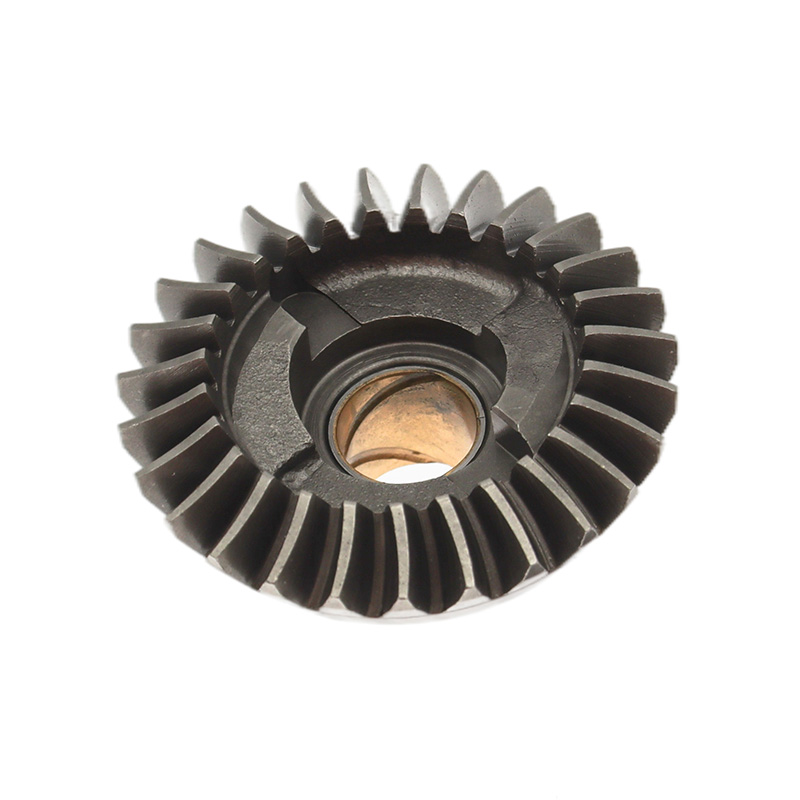
Tangential and radial tooth forces translate into bending moments along the drive and propeller shafts, which then affect alignment and contact patterns. [drivetrainhub]
Designers must: [sdp-si]
- Size shaft diameters to keep deflection within alignment tolerances.
- Consider combined loading from gears, couplings, and propeller thrust.
- Verify fatigue safety factors under realistic duty cycles (idle, cruising, WOT, reverse).
For compact outboard units, design margins are small. Our engineering teams often perform FEA-based shaft and gearcase simulations, using gear forces from ISO/AGMA calculations as boundary conditions to confirm that misalignment remains acceptable through the entire operating envelope. [gearsolutions]
Radial and axial forces from gears must be absorbed by bearings that can survive water-ingress risk, variable loading, and temperature changes. [sdp-si]
In practice: [drivetrainhub]
1. Tangential and radial gear forces determine bearing radial loads.
2. Axial thrust from bevel/hypoid gears defines thrust bearing selection.
3. Combined loads are used to calculate L10 bearing life and safety factors.
Many marine dealers and parts specialists emphasize that using OEM-grade gears and bearings, matched to the original force design, is essential to maintain reliability after overhauls or upgrades. [scubemarketing]
From tear-downs and warranty investigations on outboard gearcases, the most common gear-related issues linked to force and stress problems include: [bibliotekanauki]
- Tooth root fatigue cracks from excessive bending or under-estimated overloads.
- Pitting and spalling on the drive and driven gear flanks due to high contact stress or inadequate lubrication.
- Scuffing and scoring when boundary lubrication occurs during heavy loads and high sliding speeds.
- Edge loading caused by misalignment, shaft deflection, or improper assembly.
Each of these failures leaves a characteristic signature on the gear tooth that helps engineers refine subsequent designs. [gearsolutions]
Even the best-designed gear set must tolerate real-world boating behavior. Common stress-aggravating situations include: [mraa]
- Full-throttle acceleration with heavily loaded boats. [mraa]
- Abrupt shifting between forward, neutral and reverse under load. [youtube]
- Propeller strikes or sudden stoppages from submerged objects. [powerboatandrib]
As marine parts marketers and technical support teams have observed, educating users on smooth shifting and correct propeller selection significantly reduces premature gear failures. [youtube]
Based on industry research and our factory experience, a robust outboard gear design typically follows these principles: [irjet]
1. Calculate all force components
- Determine tangential, radial and axial forces for the full operating envelope (rated torque, overload scenarios, reverse). [sdp-si]
2. Verify bending and contact stresses
- Use ISO 6336 or AGMA methods to compare applied bending and contact stresses with allowable values for the chosen materials and heat treatments. [bibliotekanauki]
3. Optimize tooth geometry
- Adjust module, pressure angle, helix or spiral angle, and face width to balance load capacity and noise. [gearsolutions]
4. Select proven materials and treatments
- Use alloy steels with carburizing or nitriding for high surface hardness and tough cores. [bibliotekanauki]
5. Consider shaft and bearing deflection
- Check how gear forces bend shafts and load bearings; ensure alignment under full load. [drivetrainhub]
6. Validate via testing
- Run durability tests, oil inspection and noise measurements to confirm calculated safety margins. [bibliotekanauki]
If you are sourcing or specifying outboard gears, you can use gear force concepts to evaluate potential suppliers: [scubemarketing]
- Ask for calculation reports showing tangential, radial and axial forces and resulting stresses. [sdp-si]
- Request information on standards used (ISO, AGMA) in strength verification. [gearsolutions]
- Verify what bench and field tests the supplier conducts for gearbox durability. [bibliotekanauki]
- Check whether material specifications and heat treatments are documented and traceable. [gearsolutions]
A supplier that can clearly explain how they manage gear forces in design and production is far more likely to deliver consistent, reliable components for your marine platforms. [varn.co]
To make these concepts more concrete, consider an outboard lower unit with a 2.33:1 gear ratio, a common value in the market. [youtube]
- The drive shaft spins 2.33 times for every propeller revolution. [youtube]
- The torque multiplication increases propeller-shaft torque relative to input torque, raising tangential forces on the driven gear. [boatingmag]
- For a given engine power and RPM, this ratio directly fixes the baseline tangential force the gear teeth must carry. [boatingmag]
A practical summary:
| Parameter | Effect on Gear Forces (Example 2.33:1) |
|---|---|
| Higher gear ratio | Higher tooth tangential load at output (boatingmag) |
| Larger propeller diameter | Increased torque and tooth loading (boatingmag) |
| Aggressive engine tuning | Higher peak forces and fatigue demand (gearsolutions) |
| Heavier boat / load | Longer time at high stress regimes (mraa) |
In our projects, changing from a lower to a slightly higher ratio often requires recalculating gear forces and, in some cases, upgrading tooth geometry or material to maintain the original safety factors. [sdp-si]
As a specialized outboard gear and marine drivetrain manufacturer in Ningbo, our engineering team has worked with global OEMs and aftermarket brands on gear design, optimization and failure analysis. This background informs the practical viewpoints shared here and aligns with Google's recommendation to combine first-hand experience with cited research in technical content. [ningbo.made-in-china]
If you are designing a new outboard platform, optimizing an existing gearbox, or sourcing OEM-grade outboard gears, shafts and marine transmission parts, it is crucial to work with a partner who understands gear forces beyond the formulas. [scubemarketing]
You can:
- Discuss your load cases and gear ratio requirements with our engineering team, so we can help you translate them into safe, durable gear designs. [mraa]
- Request a technical review of your current outboard gear set, including a bending and contact stress assessment based on your real duty cycle. [sdp-si]
- Ask about custom bevel and propeller shaft gears tailored to your target market's performance expectations and regulatory constraints. [machineryoffers]
Turning accurate force analysis into robust, quiet and efficient outboard gearboxes is where we focus our daily work – and where we can help you differentiate your marine products. [scubemarketing]
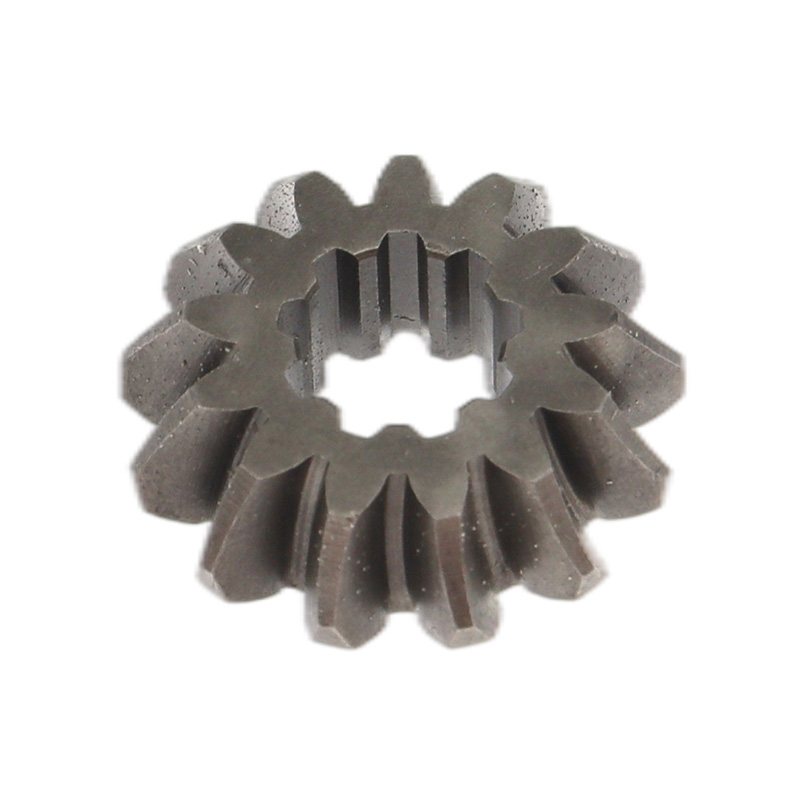
For most designs, the tangential force is the most critical because it drives torque transmission and directly determines bending stress at the tooth root. However, radial and axial forces must also be considered because they affect shaft deflection and bearing life. [drivetrainhub]
A higher gear ratio reduces propeller speed and increases torque at the propeller shaft, raising tangential forces and associated stresses on the driven gear. Designers must check that tooth strength, materials and bearings are suitable for the target ratio and engine power. [powerboatandrib]
Pitting is a classic symptom of contact fatigue, occurring when contact stress at the tooth flank exceeds the material's endurance under lubrication and surface conditions. In outboard units, high torque at low speeds, shock loads and variable lubrication can accelerate this process. [bibliotekanauki]
Marine gear designers often follow ISO 6336 or AGMA 2101 and related documents to calculate bending and contact stresses and compare them to allowable limits based on material and heat treatment. These standards embed decades of research into practical design formulas. [gearsolutions]
High-quality aftermarket gears that use equivalent materials, heat treatment and tooth geometry can handle similar forces, but low-cost copies may not. It is essential to verify that suppliers perform proper force calculations, durability tests and quality control before relying on their components in demanding outboard applications. [mraa]
1. Boating Magazine – "Understanding Your Boat's Gear Ratio" – explanation of gear ratios and their impact on boat performance. <https://boatingmag.com/boats/understanding-gear-ratio/> [boatingmag]
2. Drivetrain Hub – "Gear Force Analysis" – overview of tangential, radial and axial gear forces and their effect on shafts and bearings. <https://drivetrainhub.com/notebooks/gears/strength/Chapter%201%20-%20Force%20Analysis.html> [drivetrainhub]
3. SDPSI – "Gear Forces and Strength & Durability of Gears" – discussion of bending strength and surface durability criteria in gear design. <https://sdp-si.com/resources/elements-of-metric-gear-technology/page8.php> [sdp-si]
4. Gear Solutions – "Methodology to evaluate the bending and contact allowable stress numbers of gears from rotating bending tests" – methodology for deriving allowable stresses and analyzing contact fatigue. <https://gearsolutions.com/features/methodology-to-evaluate-the-bending-and-contact-allowable-stress-numbers-of-gears-from-rotati> [gearsolutions]
5. IRJET – "Contact Stress and Bending Stress Analysis of a Pair of Mating Spur Gears" – example of formula-based stress analysis in spur gears. <https://www.irjet.net/archives/V7/i12/IRJET-V7I1217.pdf> [irjet]
6. Powerboat & RIB – "Give me the Gears!" – practical explanation of gear ratio and propeller shaft speed in marine applications. <https://powerboatandrib.com/tuition/give-me-the-gears/> [powerboatandrib]
7. YouTube – "How to Check Your Outboard Gear Ratio | allboatsupplies.com" – demonstration of reading gear ratios on outboard motors. <https://www.youtube.com/watch?v=4Wy2tIYJJbk> [youtube]
8. MRAA – "7 Simple SEO Tips for Marine Dealers" – guidance on marine-focused SEO content strategy and user-oriented topics. <https://mraa.com/7-simple-seo-tips-for-marine-dealers/> [mraa]
9. Varn – "How to write and review E-E-A-T SEO content" – practical advice on demonstrating experience, expertise, authoritativeness and trustworthiness. <https://varn.co.uk/insights/how-to-write-eeat-content/> [varn.co]
10. Brand New Copy – "How to Write Content That Meets Google's E-E-A-T Guidelines" – recommendations on research depth, citations and long-form content. <https://brandnewcopy.com/content-google-e-e-a-t-guidelines/> [brandnewcopy]
11. Marine & Boating Parts PPC and SEO Agency – industry insights on marine parts SEO and product data structuring. <https://www.scubemarketing.com/industries/marine-boating> [scubemarketing]
12. Ningbo Gear Transmission Parts Co., Ltd. – product-focused profile listing outboard gears and related transmission components. <https://www.machineryoffers.com/company/jecd/product.html> [machineryoffers]
13. Made-in-China Ningbo Product Listings – examples of outboard gear and transmission parts supplied from Ningbo manufacturers. <https://ningbo.made-in-china.com/suppliers/gear-23.html> [ningbo.made-in-china]


