


close
Choose Your Site
Global
Social Media
Views: 299 Author: Gill Transmission Parts Publish Time: 2026-11-17 Origin: Site


Content Menu
● Surface-Hardened vs Through-Hardened Gears at a Glance
● What Are Surface-Hardened Gears?
>> Carburized Gears: A Hard Case Supported by the Core
>> Induction-Hardened Gears: Specify the Hardened Pattern
>> Nitrided Gears: High Surface Hardness With a Shallower Layer
● What Are Through-Hardened Gears?
● How Heat Treatment Affects Outboard Gear Performance
>> Tooth Contact Fatigue vs Root Bending Fatigue
>> Heat-Treatment Distortion, Backlash, and Noise
>> Lubrication and Water Contamination
● Three Practical Checks Before Specifying Outboard Gears
>> 1. Compare the Governing Failure Mode, Not the Hardness Number
>> 2. Turn the Drawing Into an Inspection Plan
>> 3. Compare Quotes on the Same Finished-Part Basis
● Which Gear Hardening Method Should You Choose?
>> 1. Are surface-hardened gears stronger than through-hardened gears?
>> 2. Are all outboard gears carburized?
>> 3. Is surface hardness enough to verify a case-hardened gear?
>> 4. Can a through-hardened gear replace a surface-hardened gear with the same dimensions?
>> 5. Does a deeper case always extend gear life?
>> 6. Which type of gear costs less?
Surface-hardened gears have a deliberately hardened outer layer supported by a core with different mechanical properties. Through-hardened gears are heat-treated to achieve a specified hardness across the working section, without relying on a separately engineered hard case. For outboard gears, the choice comes down to which design meets the required tooth-contact and bending loads, retains the correct geometry after heat treatment, and can be verified consistently in production.
At Ningbo Gill Transmission Parts Co., LTD., we bring 29 years of experience in the development, manufacture, and sale of outboard gears and other marine transmission parts. From a supplier's perspective, the first question I would ask is not "Which gear has the higher hardness?" It is "Where does this gear need hardness, what must the material underneath withstand, and how will we verify both on the finished part?"
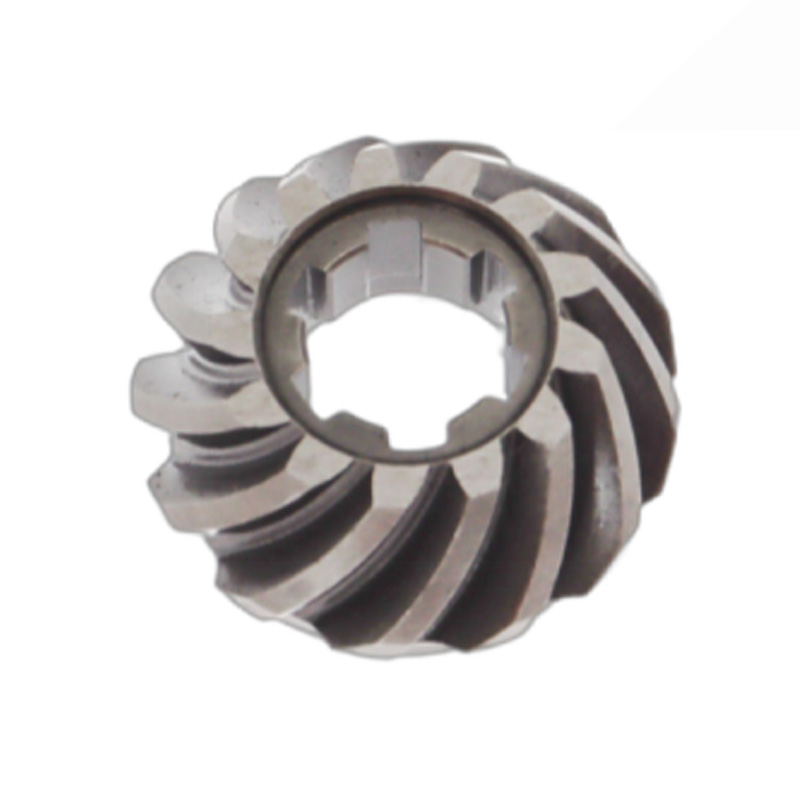
| Comparison factor | Surface-hardened gears | Through-hardened gears |
|---|---|---|
| Hardness distribution | Hard outer layer or selected hardened zones, with properties that change toward the core | Hardness targeted across the working section; actual uniformity depends on steel hardenability and part size |
| Typical processes | Carburizing and hardening, induction hardening, or nitriding | Commonly quenching and tempering of a suitable steel |
| Main design advantage | Can combine hard tooth flanks with a core selected for strength and toughness | Can meet the required load rating without specifying a separate hardened case |
| Contact performance | Often favored when repeated contact stress limits a compact design | Can be appropriate when tooth-contact and root-bending ratings both meet the required margins |
| Finishing considerations | Verify finished geometry and, where applicable, retained case depth after stock removal | Verify dimensional change and hardness at the specified location |
| Key inspection evidence | Surface hardness, depth profile, core hardness, and hardening pattern as applicable | Hardness at defined locations, material traceability, and finished geometry |
| Cost comparison | Depends on process, tooling, batch size, finishing, and inspection | May cost less for a suitable design, but gear size, steel grade, and finishing can change the comparison |
Surface hardening changes the properties of the outer region of a gear tooth. Its purpose is to put hardness where the teeth contact while retaining suitable properties beneath that layer. The three common routes below do not produce interchangeable hardness profiles.
Carburizing adds carbon to the surface of a suitable steel. Subsequent hardening produces a hard case over a lower-carbon core. This makes carburizing a strong candidate for compact, heavily loaded gearing where the flanks must withstand repeated contact and the tooth still needs adequate core support.
A useful specification controls effective case depth, not just surface hardness. Effective case depth is the distance from the surface to a defined hardness threshold under an agreed test method. If the teeth are ground after heat treatment, the depth requirement should apply to the finished surface. A result taken before grinding does not establish how much case remains on the delivered gear.
Induction hardening heats selected areas rapidly using an electromagnetic field. Quenching hardens those areas without adding carbon. Steel composition, coil arrangement, and tooth geometry affect the resulting pattern.
State whether the hardened zone must cover the flank, the root, or both. A passing flank hardness reading does not demonstrate acceptable hardening at the tooth root. This distinction matters when repeated bending at the root, rather than flank wear or pitting, is the limiting concern.
Nitriding introduces nitrogen into the surface of a suitable steel. It generally does not require a quench after nitriding, making it worth evaluating when dimensional stability is important.
The hardened layer is generally shallower than a carburized case. A high surface hardness therefore does not establish that a nitrided gear can replace a carburized one. Review the required depth and load capacity, and specify any post-treatment stock removal rather than assuming both gears can be finished the same way.
Through-hardened gears typically use a steel that is quenched and tempered to reach a target hardness and strength across the relevant section. Tempering helps balance hardness with toughness after quenching. Steel hardenability, meaning its ability to develop hardness below the surface during cooling, affects how closely the interior reaches the target.
"Through-hardened" does not mean that every point in a gear has identical hardness. A thin tooth and a thick hub can cool differently. For that reason, a drawing should identify the test location rather than give a hardness range with no indication of where it applies.
Through hardening is a practical option when the gear geometry and material provide sufficient contact-fatigue and bending capacity. It can also simplify the purchase specification by eliminating a separate case-depth requirement. It is not, however, a drop-in substitute for a case-hardened gear that depends on a hard flank and a different core hardness.
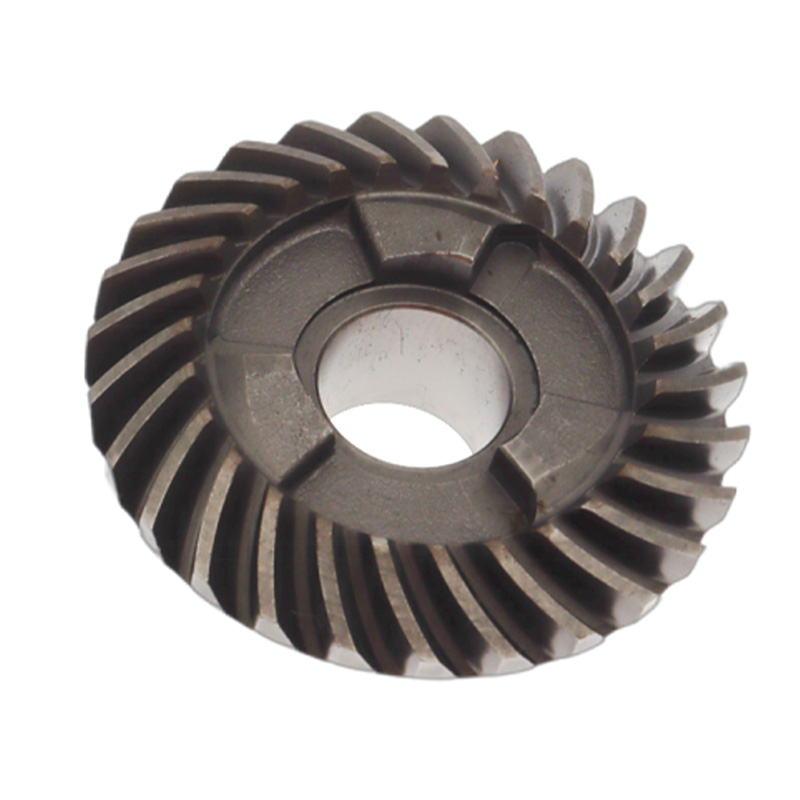
Repeated contact can produce pitting on the flank, the working side of the tooth. Repeated bending can initiate a crack at the root, where the tooth joins the gear body. These are different failure modes. Improving resistance to one does not automatically improve resistance to the other.
For an outboard bevel gearset, assess surface durability and tooth-root strength separately using the applicable bevel-gear rating method. Also verify the contact pattern under the specified conditions. A harder flank does not correct a gearset that concentrates the load near an edge because of geometry, assembly, or deflection.
Both heat-treatment routes can change part geometry. On a bevel gearset, those changes can affect where the teeth contact and how consistently the gear pair runs. Backlash, the clearance between mating teeth, and tooth contact should therefore be checked at the assembly conditions specified for the gearset.
When comparing quotes, ask which tooth finishing operations occur after heat treatment and which final inspection results will be supplied. A lower price for the heat-treatment step tells you little if the quoted part still needs additional finishing or cannot consistently meet the assembly requirements.
A hardened case is not a substitute for good gearcase lubrication or intact seals. If an outboard lower unit shows suspected water contamination, investigate the leak and lubricant condition before blaming the heat treatment. Review the existing gear pair, contact pattern, and bearing condition as well. Replacing the damaged gear without addressing the cause can leave the replacement exposed to the same problem.
Consider a compact outboard pinion whose proposed through-hardened design meets the tooth-root strength requirement but falls short on flank surface durability. A carburized version is worth evaluating. The next step is to rate that design using the proposed material and heat treatment, then verify the finished case depth and the mating gear's contact pattern. Selecting a higher surface hardness alone does not close the engineering review.
Now consider a gearset that already meets both ratings but repeatedly shows damage concentrated near one edge of the tooth. Start by investigating contact pattern, assembly settings, bearing condition, and alignment before specifying a harder gear. These are hypothetical examples, not claims about measured service life. The point is to choose a corrective action that fits the evidence.
Before approving a first article, agree with the supplier on the following:
1. Identify the drawing revision, steel grade, heat-treatment route, and mating part.
2. State the hardness range, test method, and exact measurement location. For a through-hardened gear, clarify whether hardness at more than one location must be verified.
3. For a surface-hardened gear, define the required depth, the applicable hardness threshold, and where the section is taken. Include core hardness and root or flank coverage where relevant.
4. Specify which geometry, runout, surface finish, and contact checks apply after final machining.
5. Agree on lot traceability, first-article records, production sampling, and which process changes require renewed approval.
Where a depth measurement is required, ask for a hardness traverse: a series of readings at increasing distances from the finished surface on a sectioned sample. It shows how hardness changes below the surface, something a single reading cannot establish.
Send every supplier the same drawing and request the same inspection deliverables. Separate one-time tooling or qualification charges from recurring part costs. Confirm whether the quoted price includes post-treatment finishing, destructive testing where required, and the final inspection report.
Compare the two options at the same acceptance criteria and order volume. Through hardening may be more economical when it already meets the rating and geometry requirements. If it does not meet those requirements within the available gearcase envelope, the cheaper treatment is not a viable substitute.
Evaluate surface hardening when high tooth-contact stress, limited gear size, or a specified hard surface and tougher core make it necessary to engineer a hardness gradient. Evaluate through hardening when the material and geometry meet both contact and bending requirements without a separate case. For an existing outboard replacement, retain the approved material, treatment, and mating requirements unless the alternative has been qualified.
Send Ningbo Gill Transmission Parts Co., LTD. your gear drawing or part number, mating gear details, operating conditions, and expected order quantity. State whether you need a like-for-like replacement or an engineered alternative. If you are investigating premature failure, include photos of both mating gears and note where the damage appears. This gives us a starting point for discussing a manufacturing route, the inspection scope, and a quotation.
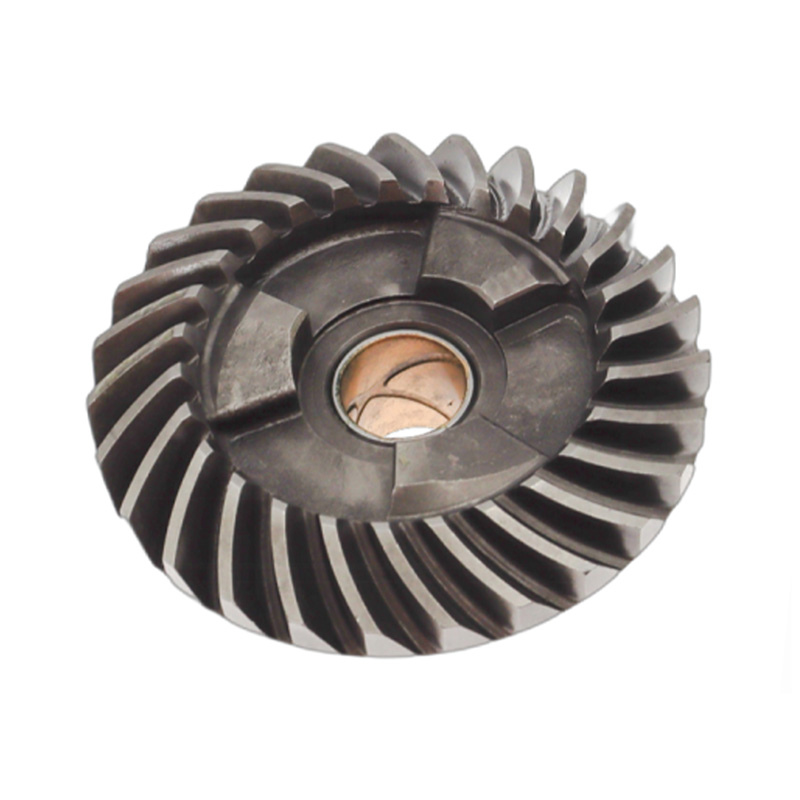
Not in every sense. Surface hardening can improve resistance to contact fatigue, but tooth-root strength depends on geometry, steel, hardening pattern, and loading. Compare both ratings instead of treating surface hardness as proof of overall strength.
No single heat treatment should be assumed for every outboard gear. Carburizing is a candidate for compact, highly loaded bevel gears, but the correct route for a replacement comes from the approved specification or documented engineering validation.
No. It tells you how hard the tested area is, but not how deep the hardened layer extends or whether the required tooth regions are covered. Specify the depth test and measurement location where they affect performance.
Only after the substitution is qualified. Matching dimensions establishes neither equivalent load capacity nor equivalent service life. Check the material and hardness profile, the load rating, and compatibility with the mating gear.
No. The depth must suit the tooth geometry, loading, and core requirements. Specify a justified range on the finished gear rather than asking the supplier to maximize depth.
Through hardening can cost less when it meets the same functional requirements. Compare complete finished-part quotes, including steel, tooling, heat treatment, finishing, and inspection, rather than comparing heat-treatment charges alone.
- KHK Gears, *Gear Materials and Heat Treatments* — gear steels and the differences among through hardening, carburizing, induction hardening, and nitriding. [khkgears]
- International Organization for Standardization, *ISO 6336-5:2016 — Calculation of load capacity of spur and helical gears, Part 5: Strength and quality of materials* — material quality, heat treatment, and limit stresses used in applicable rating methods, including bevel gear rating. [iso]
- International Organization for Standardization, *ISO 10300-2:2023 — Calculation of load capacity of bevel gears, Part 2: Calculation of surface durability (macropitting)* — bevel-gear flank surface durability and rating limitations. [iso]
- International Organization for Standardization, *ISO 10300-3:2023 — Calculation of load capacity of bevel gears, Part 3: Calculation of tooth root strength* — bevel-gear bending assessment and its scope. [iso]
- American Gear Manufacturers Association, *AGMA 923-C22 — Metallurgical Specifications for Steel and Cast Iron Gearing* — metallurgical quality characteristics, heat-treatment categories, and related inspections. [members.motionpower]
- Atlantic Boat Repair, *Lower Unit Oil: Your Complete Outboard Maintenance Guide* — lower-unit lubrication and signs of possible water intrusion. [atlanticboatrepair]


